1300 786 560
 Australia
Australia
Australia
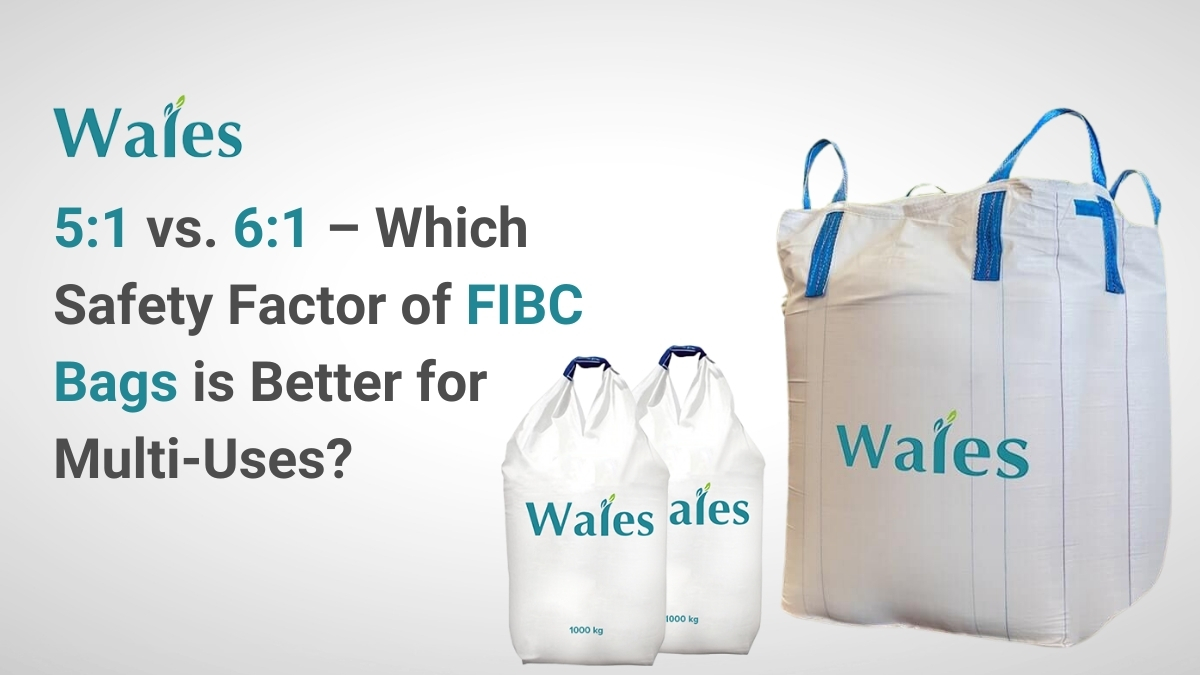
FIBC bags play a critical role in businesses that require the secure dealing with, capacity, and transportation of bulk materials. When selecting an FIBC bag for your business needs, understanding the security factor is pivotal. The two common safety factor ratings for FIBC bags are 5:1 and 6:1, which show their quality and strength. But which one is safer for multiple uses? In this article, we’ll investigate the contrasts between 5:1 and 6:1 FIBC bags, their appropriateness for diverse applications, and how to choose the proper one for your business.
The safety factor (SF) of an FIBC bag refers to the proportion of the bag’s rated safe working load (SWL) to its tested breaking quality. This rating ensures that FIBC sacks meet strict industry standards for quality and durability. The safety factor is a key measure of how much weight a bag can handle under ordinary operating conditions.
For example:
The higher the safety factor, the stronger and more durable the bag. But does that mean a 6:1 FIBC bag is always the superior choice? Let’s break it down further.
5:1 FIBC bags are designed for single-use applications and are regularly referred to as Single Trip Packs (STP). They are widely used across multiple industries for transporting dry, flowable materials such as:
These bags are made with solidness in intellect, but they are not aiming for reuse. Whereas they can handle a stack five times their appraised capacity, they are frequently arranged of or reused after one utilization to dodge any chance of failure.
On the other hand, 6:1 FIBC bags are classified as Multi-Trip Bags, meaning they are designed for repeated use under particular conditions. These bags undergo stricter quality control measures and are developed with fortified fabric and sewing to withstand different filling, lifting, and discharge cycles.
Common industries that prefer 6:1 FIBC bags include:
To ensure safe reuse, 6:1 FIBC bags must meet the Australian standard AS3668-1989 for reusability. They must also be properly assessed and reconditioned before each use.
| Feature | 5:1 FIBC Bags (Single Trip) | 6:1 FIBC Bags (Multi-Trip) |
| Intended Use | Single-use | Multiple-use |
| Durability | Standard | High |
| Strength | Rated 5 times SWL | Rated 6 times SWL |
| Cost | Lower | Higher |
| Reusability | No | Yes |
| Industry Use | Construction, Chemicals | Mining, Heavy Industries, Agriculture |
The decision between 5:1 and 6:1 FIBC bags depends on your specific business necessities. Here are many factors to consider when selecting the right bulk bag:
If you select to use 6:1 safety factor FIBC bags, follow these best practices to ensure safety and life span:
Both 5:1 and 6:1 FIBC bags serve essential parts in industrial applications, but 6:1 bags are the more secure alternative for different uses. Their higher solidness, reinforced structure, and compliance with multi-trip standards make them the preferred choice for businesses looking to reuse bulk bags productively.
However, if your operation requires single-use bags for cleanliness or cost reasons, 5:1 FIBC bags stay a reliable arrangement. The key to making the proper choice is evaluating your industry necessities, budget, and supportability goals.
For high-quality FIBC bags that meet rigid security and industry measures, select Wales Industries. Our range of bulk bags is planned for sturdiness, quality, and capability. Contact us today to discover the culminated FIBC solution for your trade!
Get in touch with Wales Industries for top-quality FIBC bags today!
Australia
 中国 (China)