1300 786 560
 Australia
Australia
Australia
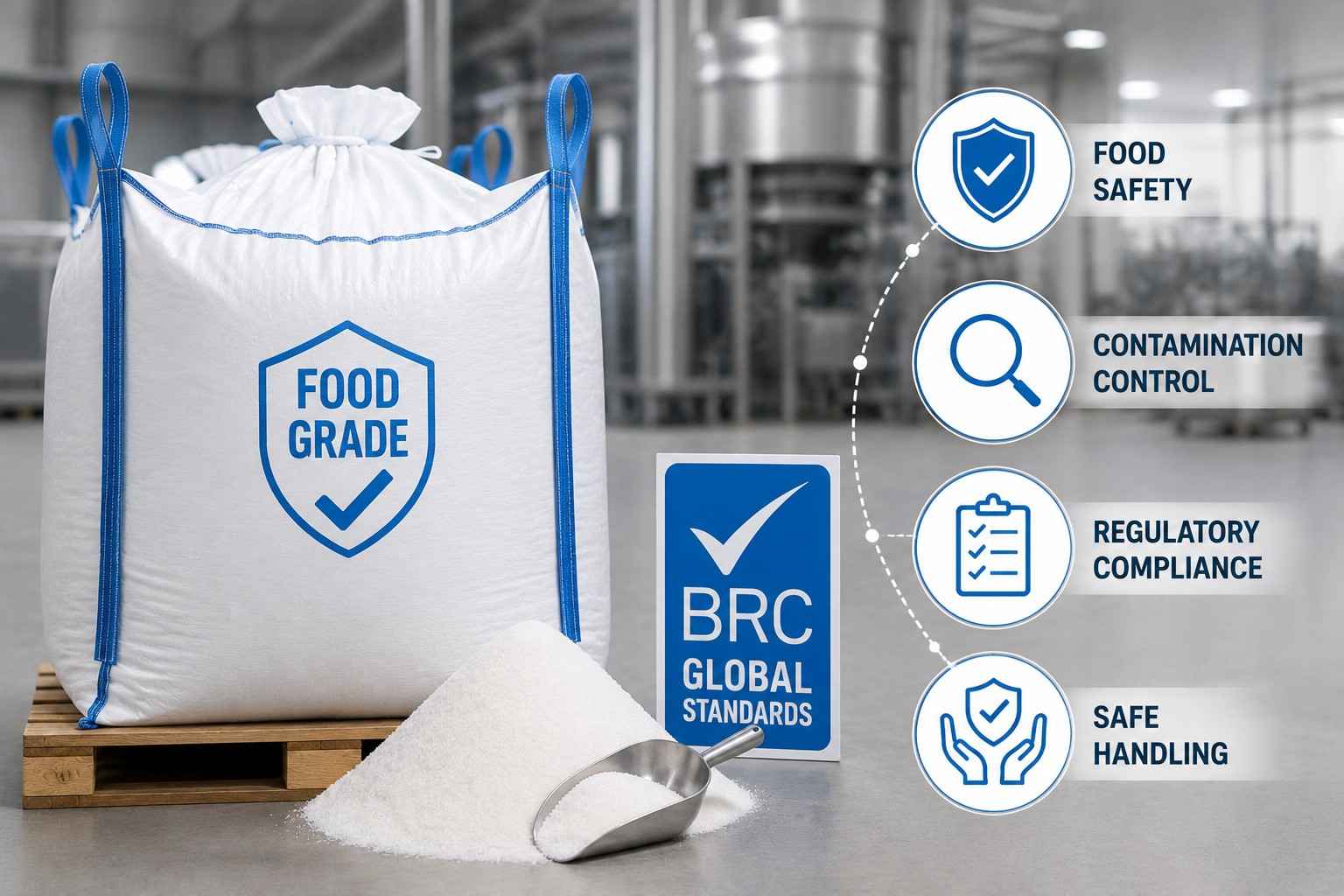
Food safety starts long before a product reaches the shelf. It begins at the point of packaging. For businesses that handle bulk food ingredients, choosing the right FIBC bag is not just a logistics decision. It is a food safety one.
Across the food industry, contamination risks tied to bulk packaging are taken seriously at every level. A single non-compliant bag can trigger a product recall, damage supplier relationships, and put consumers at risk.
That is why food-grade FIBC compliance, backed by recognized standards like BRCGS and GFSI, has become a non-negotiable requirement for responsible food producers and distributors.
This guide covers what food-grade FIBC compliance actually involves, what BRC Global Standards expect from packaging manufacturers, and how contamination control is managed in a certified production environment.
A food-grade FIBC is a large bulk bag built to carry food ingredients. Think grains, flour, sugar, rice, starch, and other dry food products. These are not regular bulk bags.
They are made using 100% virgin polypropylene resin that meets FDA food contact standards. No recycled material is used. Recycled resin carries a contamination risk that is too high for food use.
Food-grade FIBCs must also be free from odor, color migration, and any chemical residue that could transfer to the food inside.
BRC stands for British Retail Consortium. The BRCGS certification is one of the most trusted food safety frameworks in the world. It is also accepted under GFSI, the Global Food Safety Initiative.
For packaging makers, the BRCGS Packaging Materials standard sets clear rules across:
Over 30,000 sites across more than 130 countries hold BRCGS certification. That number shows how widely the food supply chain relies on this standard.
Food manufacturers need to know their packaging will not become a contamination source. BRCGS certification for the bag maker is proof that the facility follows audited, internationally recognized food safety procedures.
At Wales Industries, food-grade FIBC bulk bags are made in BRC-certified facilities that align with GFSI requirements. Every bag goes through controlled production steps built to meet the standards expected by the food, pharmaceutical, and chemical sectors.
Contamination in bulk packaging can come from a few directions. Physical contaminants like metal or dust. Chemical contamination from non-food-safe materials. Biological risks from poor hygiene. Controlling all three needs verified systems, not just good intentions.
Wales Industries uses a multi-step contamination control process:
These are not occasional checks. Each step runs consistently across every production batch.
HACCP stands for Hazard Analysis and Critical Control Points. It is a preventive approach to food safety. It identifies potential hazards and puts controls in place before a problem occurs.
For packaging makers, HACCP means documenting critical control points, setting clear limits, and checking that those limits are being met. It turns food safety from a reactive fix into a planned system.
According to industry data, foodborne illness affects roughly 600 million people globally each year. Safe packaging is one of the simplest ways to reduce that risk at the supply chain level.
Before choosing a food-grade FIBC supplier, ask these questions:
These questions separate a genuinely compliant supplier from one that just claims food-grade without the systems to prove it.
Wales Industries has been supplying food-grade FIBC bulk bags across Australia since 2016. With technical know-how and practical food industry experience, the team has production in BRC-certified facilities and has served over 500 clients.
Wales Industries ‘ food-grade bags are used in grain, flour, sugar, starch, and other dry food ingredient applications. The range includes 1 and 2-loop FIBC bags, 4-loop bulk bags, and baffle bags. All are available with food-grade liner options to suit different storage and discharge arrangements.
Wales Industries is a reliable choice for food businesses that need compliant bulk packaging with no long wait times; they have warehouses throughout Australia and same-day shipping on many lines.
Food-grade FIBC compliance is not hard to understand once you know the basics. The right bag, made in a certified facility, with proper contamination controls, protects your product and your business.
BRC Global Standards give food producers a clear, audited benchmark to measure their packaging suppliers against. Steps like metal detection, light inspection, and air washing are not extras. They are basics every serious supplier should already have in place.
If you are still using bulk bags not made for food contact, or sourcing from a supplier without BRCGS certification, the risk is real. One contamination incident can cost far more than any savings made on cheaper bags.
Wales Industries has been helping Australian food businesses get this right since 2016. When the bag matters as much as what goes inside it, it pays to choose a supplier who takes food safety as seriously as you do.
To learn more or get a quote, visit walesindustries.com.au or call 1300 786 560.
Australia
 中国 (China)