1300 786 560
 Australia
Australia
Australia
When purchasing FIBC bulk bags, most buyers focus on size, load capacity, and cost. The safety factor rating rarely gets the attention it deserves.
Yet that small ratio on the bag label is one of the most important specifications in bulk material handling. Choosing the wrong one can result in bag failure, lost product, or a workplace injury that could have been avoided.
This guide explains what FIBC safety factors mean, why the difference between 5:1 and 6:1 is significant, and how to pick the right bag for your operations.
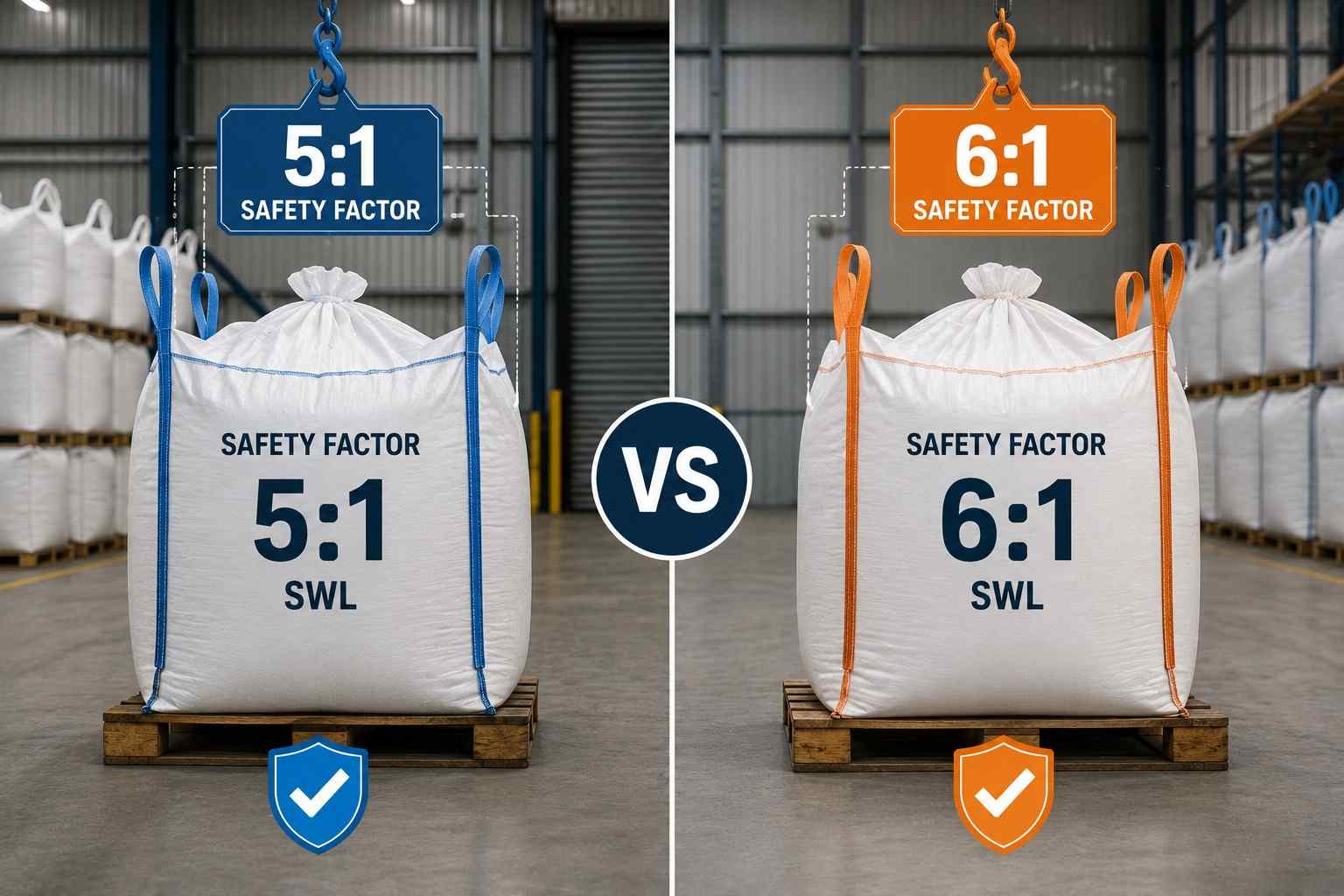
Every FIBC has a Safe Working Load, or SWL. This is the maximum weight the bag is rated to carry during normal use. The safety factor tells you the ratio between the bag’s tested break strength and its SWL.
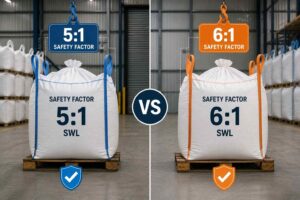
Take a bag with a 1,000 kg SWL and a 5:1 safety factor. That bag has been tested to hold 5,000 kg before it fails. A 6:1 bag with the same SWL has been tested to 6,000 kg. The difference is the buffer between normal operation and the point of failure.
That buffer is what keeps your workers, your product, and your equipment safe when conditions are not perfectly controlled.
The 5:1 safety factor is the accepted global baseline for general-purpose FIBC bags. It is the rating specified under ISO 21898, the main international standard for FIBC design and performance covering non-hazardous goods. In Australia, AS 3668-1989 also applies to flexible bulk containers used in non-dangerous goods applications.
A 5:1 rated bag is kind of the right fit for:
The global FIBC market was sitting near USD 7.8 billion in 2023, and most of the bags you see around are operating with a 5:1 rating. For plain and simple uses, it works, and it tends to keep the total cost down. There is no reason to go higher if the application does not call for it.
A 6:1 safety factor is not about being cautious for the sake of it. It is about recognizing that some applications carry more risk, and the bag needs to reflect that.
6:1 is a right fit for:
A bag used repeatedly takes a hit each cycle. The fabric stretches. Stitching experiences stress. Lifting loops wear. A bag built only to a 5:1 standard was never designed to absorb that accumulative strain. The 6:1 rating builds in the extra tolerance needed to stay safe across the bag’s working life.
In sectors like mining, construction, and chemical handling, the price gap between a 5:1 and a 6:1 bag is minor compared to the cost of a failure on-site.
Using an underrated bag is a risk with consequences that are very visible when things go wrong. Seams split under pressure. Loads drop. Bases fail when bags are stacked.
The fallout includes:
Australian workplace health and safety law places the responsibility squarely on the business to ensure equipment is suitable for the task. An FIBC bag that is not rated correctly for its application does not meet that standard.
Wales Industries has been supplying FIBC bulk bags to Australian businesses since 2016. The company does not just sell bags. It manufactures them, with end-to-end production capabilities, in-house control, and R&D sites across 6 locations in Asia.
Four sales and service locations operate across the Asia-Pacific region, with the Australian and New Zealand markets managed directly from local warehouses.
Testing at Wales Industries is carried out in-house. It covers yarn tensile strength, fabric tensile strength, and elongation, UV resistance, coating performance, cyclic top-lift testing, load-to-failure testing, topple testing, stacking tests, and breakdown voltage testing.
Wales Industries serves companies across agriculture, construction, mining, chemicals, food processing, pharmaceuticals, and fertilizer, and the clients in Sydney, Melbourne, Brisbane, Perth, Adelaide, Hobart plus regional Australia rely on a steady supply and product quality that keeps up when things get practical and a bit rough.
In terms of range, they cover 1- and 2-loop bags, 4-loop bulk bags, baffle bags, UN-certified FIBCs, and conductive bags, with custom options too. This way, you can match the load, the material type, and the compliance side, without forcing a one-size-fits-all setup.
The gap between a 5:1 and a 6:1 SWL bulk bag is not large in price, but it is significant in practice. Match the rating to the risk your operation actually carries. Single-use, low-risk work suits a 5:1 bag. Multi-trip use, hazardous materials, or demanding conditions call for a 6:1.
Wales Industries has the product range and technical knowledge to help you get that decision right. With over a decade of experience and 500+ clients across Australia, they are a reliable starting point for any bulk bag requirement.
Reach the Wales Industries team at walesindustries.com.au or call 1300 786 560.
SWL stands for Safe Working Load. It is the maximum weight the bag is built to carry under normal conditions. This number is printed on the bag label next to the safety factor. Loading beyond this figure puts the bag, the product, and the people around it at risk.
Not for every job. A 5:1 bag handles most standard, single-use applications just fine and costs less. A 6:1 bag makes sense when the work involves repeated use, hazardous contents, or tougher site conditions. Paying for a higher rating on a low-risk job adds cost without any real benefit.
A 5:1 bag is built for one trip. Using it again puts it outside what it was designed for. The fabric, stitching, and loops take stress every time the bag is loaded and lifted. If your operation requires reuse, a 6:1 multi-trip rated bag is what you need, full stop.
ISO 21898 covers non-hazardous FIBC design and performance. AS 3668-1989 is the Australian standard for flexible bulk containers for non-dangerous goods use. Dangerous goods transport requires UN certification under ADR/RID/IMDG-Code. Food-grade bags fall under ISO 22000 and BRC-S&D. Wales Industries manufactures to all of these standards.
Check the label. The SWL and safety factor ratio should both be printed on it. If the bag is being used for multi-trip work, hazardous materials, or stacking, and the label shows a 5:1 rating, it is worth reviewing with your supplier. Wales Industries can assess your current setup and recommend the right product if something needs to change.
Australia
 中国 (China)