1300 786 560
 Australia
Australia
Australia
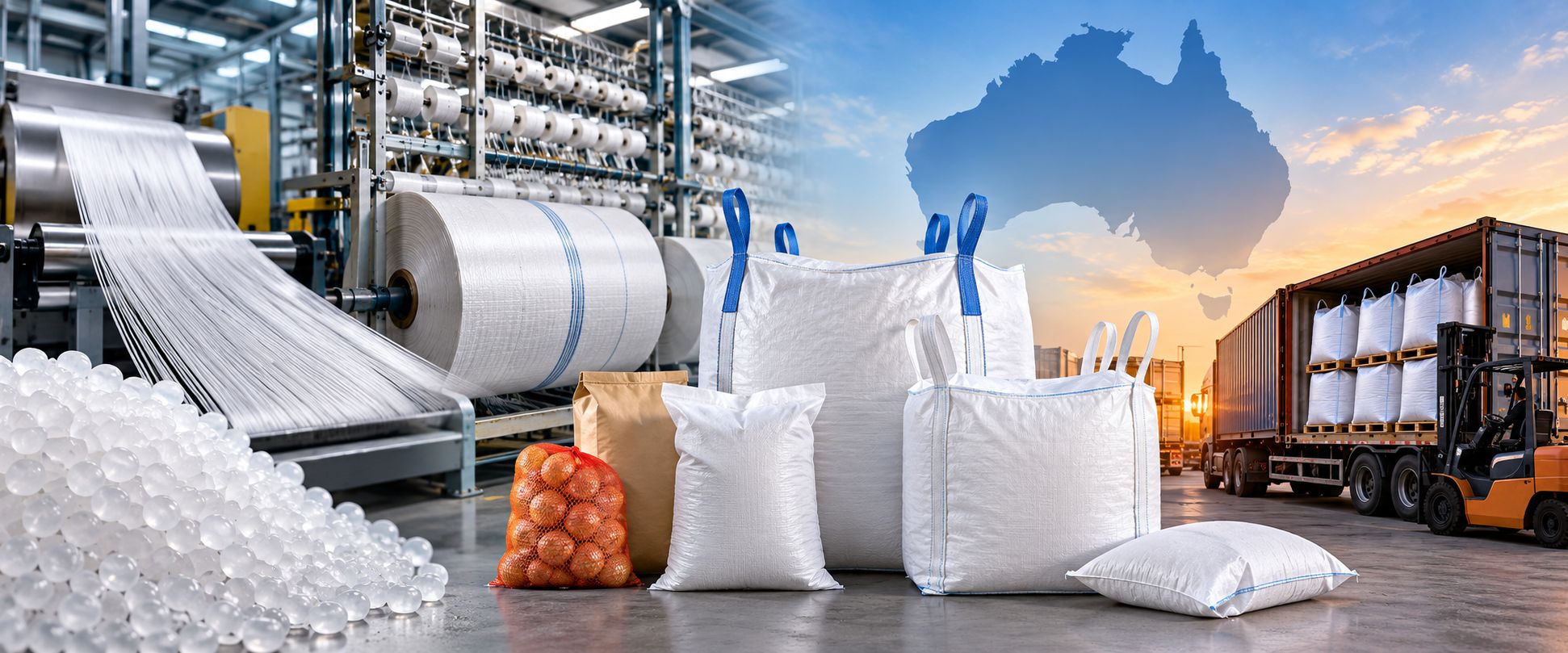
Walk into any warehouse, farm shed, or building site in Australia, and you will see them.
Polypropylene bags hold everything from fertiliser and sand to rice, seed, and construction waste.
They are affordable to make, strong for their weight, and easy to stack.
But most people never ask a simple question: who actually makes these bags, and how do they get
from a factory floor to a loading dock in Australia?
The answer involves a mix of local suppliers, offshore factories, testing labs, and shipping routes.
Understanding this supply chain helps buyers pick the right bag, at the right price, without
unpleasant surprises around quality or delivery time.
Polypropylene, often abbreviated as PP, is a tough plastic that gets woven into fabric.
That fabric is then cut and sewn into bags. Two main types dominate the bulk packaging world:
If you’re comparing different bulk bag designs, read our comprehensive guide to FIBC types to understand which configuration is suited to different applications.
Both are made in the same basic way. Polypropylene resin gets extruded into thin tapes,
woven into fabric, then cut, printed, and sewn. What separates a reliable bag from a weak
one is the quality control behind the process.
Most polypropylene bags sold in Australia are not made from a single small factory around
the corner. They come from a network of manufacturing sites, often spread across a few
countries, feeding into local warehouses for fast delivery.
Wales Industries is one example of how this works in practice. Since 2016, Wales Industries
Australia has manufactured FIBC bulk bags and paper bags, and provided supply chain solutions
for local businesses.
Rather than running one isolated factory, Wales operates as part of a larger group with:
This kind of setup lets a supplier offer both manufacturing scale and local support.
The group side handles design, tooling, and large-volume production. The Australian side
handles stock, quotes, and customer service closer to home.
Numbers help put this into perspective. According to Wales Industries, the business supplies
1.5 million products annually and has served 500 or more customers. Locally, the company
keeps over 50 types of FIBC bulk bags in stock, with same-day shipping available from
warehouses located around Australia.
That combination matters for buyers. A single order might need a food-grade FIBC one month
and a UN-certified bag for hazardous goods the next. Having many bag types on hand, backed
by a large manufacturing base, reduces the risk of running out at the wrong time.
For businesses moving large quantities of material, learn more about FIBC bags for bulk storage and transportation.
Manufacturers in this space typically produce a range of bag styles, each suited to a different job.
Understanding bulk bag construction, including U-panel, circular and 4-panel designs can also help buyers choose a bag suited to their product, handling and storage requirements.
| Bag Type | Best Suited For |
|---|---|
| 1 & 2 Loop FIBC | Lightweight bulk handling, agriculture, mineral processing |
| 4 Loop Bulk Bags | Heavy-duty loads, construction, chemical and food handling |
| Baffle Bags | Square-shaped storage, freight efficiency, food and agriculture |
| UN Certified FIBC | Dangerous goods transport |
| Conductive (Type C) Bags | Flammable powders and static-sensitive materials |
| PP Woven Sacks | Grains, sugar, flour, fertiliser, cement and general dry goods |
| Multi-Wall Paper Bags | Powdered products needing a flat, stable base |
| Mesh Bags | Onions, firewood, shellfish and other ventilated goods |
PP woven sacks are specifically built for packing 10 to 100 kg loads, with a safe working
load range of 500 kg to 2000 kg for the pallet or stack they support.
The fabric is UV-stabilised woven polypropylene, and water resistance comes from lamination
or a polyethylene liner. Common contents include rice, wheat, sugar, flour, starch, seeds,
fertiliser, cement, sand, aggregates, minerals, and recyclables.
Where moisture protection is important, learn more about water-resistant FIBC bags
and how they help protect sensitive materials.
Quality is not just a marketing word in this industry. It is checked in a lab against written standards.
Wales Industries runs its own in-house testing, including:
For more detail on the quality-control process, read what manufacturers must know about FIBC bulk bag testing
.
| Standard | Purpose |
|---|---|
| ISO 21898 | International FIBC standard for non-hazardous goods |
| ISO 13934-1 | Tensile strength of fabric and tape |
| ISO 9001 | Quality management systems |
| AS 3668-1989 | Australian standard for non-dangerous goods FIBCs |
| ADR/RID/IMDG-Code | Transport of hazardous goods by road, rail, or sea |
| BRC-S&D and ISO 22000 | Food safety in storage, distribution, and the food chain |
| EC 1935/2004, EU 10/2011 | Food contact packaging materials |
| IEC 61340 | Testing for electrostatic conductive FIBCs |
For a buyer, this matters because the right certification is not optional in industries
like food, pharmaceuticals, or dangerous goods. A bag that has not been tested against
these standards can create compliance problems down the line.
Safe Working Load is another important consideration. Read about
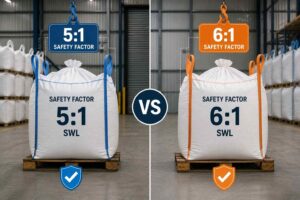
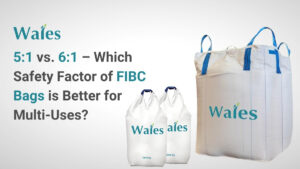
FIBC safety factors and the difference between 5:1 and 6:1 SWL bulk bags when selecting bags for different handling requirements.
Polypropylene bags and FIBCs turn up across a wide spread of sectors, including:
Each of these has different needs. A fertiliser bag does not need the same certifications
as a pharmaceutical bag. That is why manufacturers offer customised sizes, printing,
liners, and certifications rather than one generic bag for every job.
For construction applications, explore how bulk bags are used for building and landscaping supplies
.
Yes, Wales Industries Australia has manufactured FIBC bulk bags and paper bags since 2016,
with local warehouses supplying same-day shipping around the country.
The wider Wales group exports to 20 countries, with production and R&D across six sites
in Asia and four sales and service locations across the Asia-Pacific region.
Yes, PP woven sacks can be reused multiple times depending on handling, and they are recyclable,
which makes them a practical choice for repeat bulk packaging.
When made from food-grade polypropylene under controlled conditions, PP woven sacks are
suitable for food and agricultural products.
Businesses sourcing packaging for food products can also read our guide to food-grade FIBC compliance, BRC Global Standards and contamination control
.
Polypropylene bags may look simple, but the supply chain behind them is not. Making a reliable
bag takes the right resin, careful weaving, lab testing, and certification against recognised standards.
In Australia, suppliers like Wales Industries combine local stock and fast shipping with a
manufacturing network that spans six production sites across Asia and reaches 20 countries worldwide.
If you are sourcing polypropylene bags, PP woven sacks, or FIBC bulk bags
for your business, Wales Industries can help you find the right fit for your product, load, and industry.
Get in touch with Wales Industries:
Email: sales@walesindustries.com.au
Phone (Victoria): 1300 786 560
Phone (Queensland): 0424 415 316
Australia
 中国 (China)