1300 786 560
 Australia
Australia
Australia
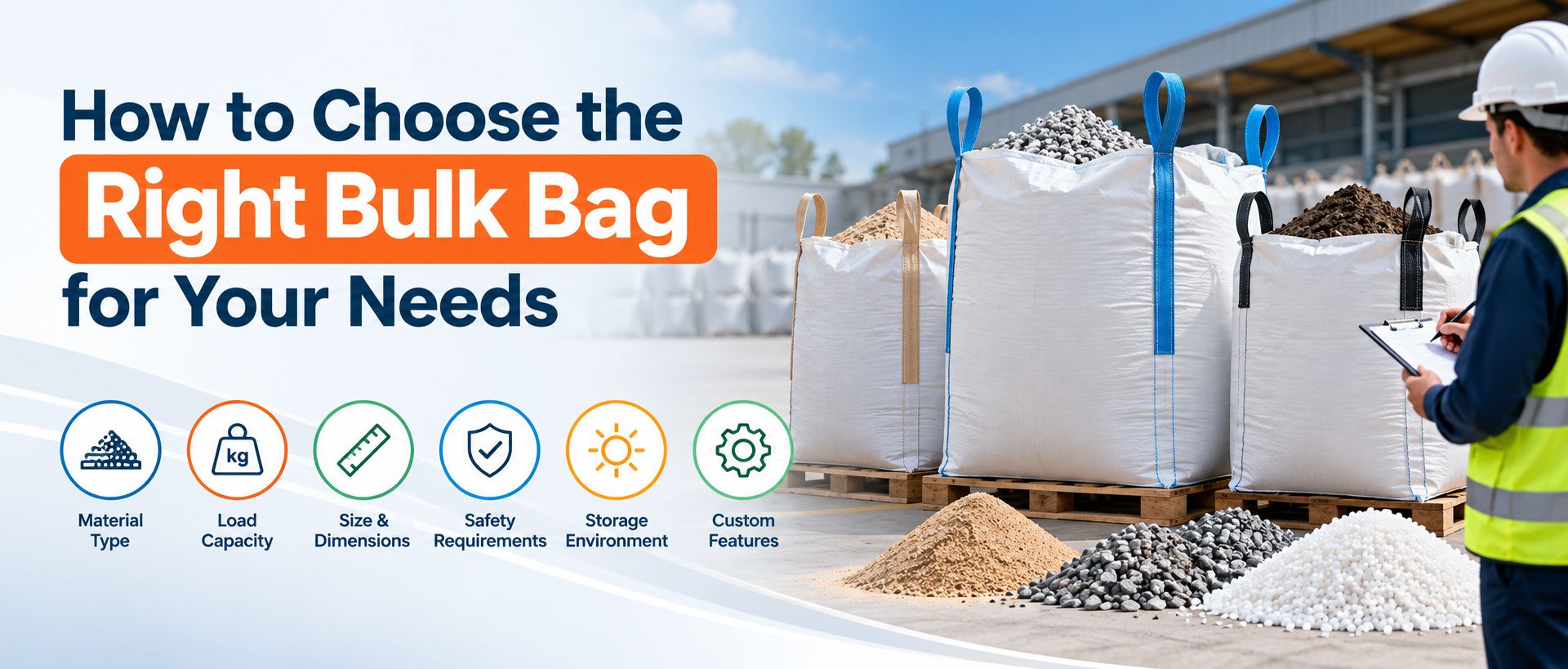
Bulk bags move a huge share of the world’s dry goods. Grain, cement, fertiliser, minerals, chemicals, and even firewood all travel in these large woven containers instead of small sacks or drums. They’re known by a few names: FIBC (flexible intermediate bulk container), big bag, or bulk bag. Whatever you call them, the idea is the same. A single bag can carry hundreds of kilograms, get lifted by a forklift or crane, and then be emptied out in one go.
The trouble is, not all bulk bags are built the same way. A bag made for sand won’t necessarily hold up to a corrosive chemical. A bag rated for a single trip shouldn’t be reused for years on end. And a bag with no anti-static protection can be dangerous around flammable powders. Picking the right one comes down to understanding a handful of key factors: loop type, safety rating, certification, and the material you’re actually packing.
This guide walks through those factors step by step, using the bag types, specifications, and standards offered by Wales Industries, an Australian FIBC manufacturer that has been supplying bulk bags since 2016.
A bulk bag is a flexible container made from woven polypropylene fabric. It’s designed to store and transport dry bulk materials safely and efficiently. Wales Industries manufactures FIBC bulk bags for construction, agriculture, food processing, and chemical handling, among other sectors. The bags are built for strength and load stability, and they’re made to work well with automated filling and handling systems.
Common materials packed into bulk bags include:
The number of loops on top of a bag changes how it gets lifted and how much it costs. This is usually the first decision to make.
These bags are made from a single tubular fabric. The body of the bag extends up into the lifting loop itself, which gives it a higher breaking strength and makes it easier to lift with a single hook or forklift attachment. Because of this simpler construction, 1 & 2 loop bags are more cost-effective than the standard 4 loop design.
Key features of Wales Industries’ 1 & 2 loop bags:
These bags are mostly used in agriculture, but they also suit powders and minerals. Typical contents include grains, sugar, salt, maize, barley, seeds, cement, sand, minerals, resins, starch, and flour.
The 4 loop design is the traditional bulk bag shape, built in either a U-shaped or circular construction. Because the load is spread across four separate lifting points, these bags offer stable handling and work well with forklifts and cranes.
Key features:
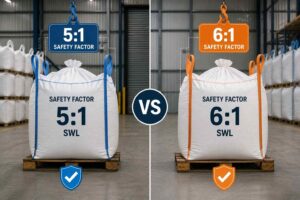
Here’s how the safety factor and design type break down for 4 loop bags:
| Safety Factor | Safe Working Load | Design Type |
| 5:1 | 500–2000 kg | Single Trip |
| 6:1 | 500–1500 kg | Multi Trip |
| 6:1 | 500–1500 kg | UN Bags |
A single-trip bag is used once and then disposed of or recycled. A multi-trip bag is built to a higher safety margin so it can be reused. If you plan to reuse your bags, the safety factor matters just as much as the load capacity.
4 loop bags are used across construction, chemicals, pharmaceuticals, agriculture, and food. Typical contents include cacao, cement, chemicals, coffee, feed, fertiliser, flour, grain, gravel, milk powder, pecans, pet food, and seeds.
If keeping a square shape during transport matters to you, a baffle bag is worth considering. Baffle FIBC bags are engineered with internal panels that stop the bag from bulging as it fills. This keeps the shape stable, which improves stacking and makes better use of container and pallet space. Wales Industries offers baffle bags in certified and food-grade options, aimed at food processing and agricultural use.
If you’re packing anything classed as a hazardous or dangerous good, this step isn’t optional. UN certified FIBC bags are built and tested according to the United Nations Recommendations on the Transportation of Dangerous Goods, often called the Orange Book. Wales Industries tests these bags for road transport (ADR), rail transport (RID), and marine transport (IMDG-Code).
The testing process includes:
Testing happens first in Wales Industries’ own laboratory, then again at an independent facility, which is how the bag earns its official UN number.
There are four recognised types of UN FIBCs made from woven plastic:
One important detail: UN bags aren’t rated by the standard 5:1 or 6:1 safety factor used for non-dangerous goods. Instead, they’re classified by packing group, which reflects the hazard level of what’s inside:
| Degree of Danger | Packing Group | UN Symbol | Max Volume |
| High | I | X | 1.5 m³ |
| Medium | II | Y | 3 m³ |
| Low | III | Z | 3 m³ |
Typical contents for UN certified bags include chemicals, pesticides, fertilisers, pigments, powders, granules, resins, additives, pharmaceuticals, and minerals.
Some powders and gases are sensitive to static electricity, and a spark at the wrong moment can be dangerous. For these situations, Wales Industries makes Type C conductive bags. These are engineered to dissipate static electricity through proper grounding during filling and discharge, which helps prevent sparks and ignition. They’re built to certified safety standards and are used for flammable powders and chemical materials in electrostatic risk environments.
Wales Industries tests every product line in its own in-house laboratory and keeps up with current industry standards. The full list of tests carried out includes:
Depending on what you’re packing and how it will be shipped, different certifications apply. Here’s a breakdown:
| Standard | What It Covers |
| ISO 21898 | International FIBC standard for non-hazardous goods |
| ISO 13934-1 | Tensile strength of fabric and tape |
| ISO 9001 | Quality management systems |
| AS 3668-1989 | Australian standard for FIBCs carrying non-dangerous goods |
| EC 94/62 | European Packaging and Packaging Waste Directive |
| Standard | What It Covers |
| ADR/RID/IMDG-Code | International transport of hazardous goods by road, rail, or sea |
| Standard | What It Covers |
| BRC-S&D | International food safety standard for storage and distribution |
| ISO 22000 | Food safety standard covering the entire food chain, including HACCP |
| EC 1935/2004 | European regulation on packaging quality for food |
| EU 10/2011 | Plastic materials intended for food contact |
| EC 2023/2006 | Materials and articles intended for food contact |
| EC 282/2008 | Requirements for recycled plastic materials |
| Standard | What It Covers |
| IEC 61340 | Testing methods for electrostatic FIBCs |
If your product needs to meet food safety rules, ask about BRC and HACCP food-grade options. If it’s a hazardous chemical, you’ll need UN certification. If it’s a flammable powder, conductive Type C bags are the safer route.
Bulk bags aren’t the only option Wales Industries offers, and depending on your product, one of these might suit you better:
| Bag Type | Best For | SWL Range | Reuse |
| 1 & 2 Loop | Agriculture, powders, minerals | 500–1500 kg | Depends on safety factor |
| 4 Loop (Single Trip) | General bulk goods, one-time use | 500–2000 kg | No |
| 4 Loop (Multi Trip) | Repeated use across shipments | 500–1500 kg | Yes |
| 4 Loop (UN Bags) | Hazardous or dangerous goods | 500–1500 kg | Classified by packing group |
| Baffle Bags | Stackable storage, food and agriculture | Varies by design | Certified/food-grade options available |
Choosing the right bulk bag comes down to answering a few clear questions. How many loops does your handling equipment need? Is what you’re packing hazardous, food-grade, or static-sensitive? Will the bag be used once or many times? Wales Industries has been manufacturing FIBC bulk bags in Australia since 2016, with over 50 bag types in stock, testing carried out in-house, and certifications covering ISO, UN, and food-grade standards. Whether you need a simple 1 & 2 loop bag for grain or a UN certified bag for hazardous chemicals, matching the bag to the job protects your product, your staff, and your supply chain.
Australia
 中国 (China)