1300 786 560
 Australia
Australia
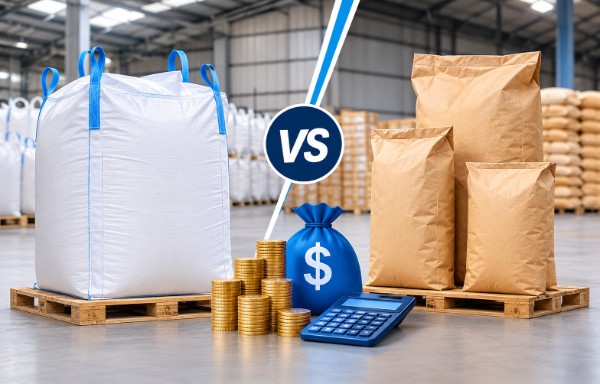
Packaging is one of the less visible decisions in the dry goods supply chain, yet it shapes costs at almost every stage. For businesses that sell cement, flour, fertiliser, seed, resin, or stockfeed, the choice of bag affects filling speed, freight efficiency, product protection, and presentation on arrival.
In Australia, two formats are commonly considered for these products. One is the bulk bag, also known as an FIBC or big bag. The other is the multi-wall paper sack. Each is designed for a different purpose, so a simple price-per-bag comparison rarely tells the full story.
This blog looks at each format and what drives total packaging cost.
Neither format is the cheaper choice in every case. The answer depends on what you pack, how much you move at once, and where the product ends up. Bulk bags are made for large dry loads. Multi-wall paper sacks are made for powdered and granular products that need to stack well and, in some cases, sit on a shelf.
Because costs vary with each application, the most useful comparison looks at the features that shape total packaging spend. These include handling, freight, storage, product, protection, and compliance.
FIBC stands for Flexible Intermediate Bulk Container. Wales Industries makes its bulk bags from high-strength woven polypropylene. They are used to store and move dry bulk materials in industries such as construction, agriculture, food processing and chemical handling.
The FIBC range includes:
Multi-wall paper bags are made for stable stacking and efficient storage of powdered and granular products. The flat base lets the bag stand upright, which helps with handling and presentation. Wales notes they are commonly used for cement, food, and industrial packaging.
Features listed on the Wales product page:
Typical contents include cement, chemicals, powders, granules, resins, polymers, spices, grains, detergents, seeds, feed and fertiliser.
The price on the quote is only part of the picture. These are the points worth weighing, based on what Wales says about each format.
A bag that fails costs more than one that holds. Wales runs product tests in its own in-house laboratory. These include:
The standards on the Wales quality page relate to its FIBC range:
The paper sack page does not list the same standards. If your product has strict requirements, ask for the details when you request a quote.
Bulk bags may suit you when:
Paper sacks may suit you when:
Not always. Wales does not publish a price comparison. Cost depends on load size, handling, freight, and how much protection the product needs. Wales says its products are designed, manufactured and tested to high standards and delivered on time at the lowest cost.
Wales lists 10 kg to 40 kg bags and 500 kg to 1.5 ton bags in its range. Its 4-loop bulk bags carry safe working loads of 500 kg to 2000 kg.
Yes, paper sacks can be customised with different sizes, materials, coatings, liners, valve options and printing. 4-loop bulk bags can be customised with liners, coatings, discharge spouts, baffles, UN certification and printing.
Wales delivers across Australia and New Zealand. Over 50 types of FIBC are in stock, with same-day shipping from warehouses across Australia. Wales names customers in Sydney, Melbourne, Brisbane, North Queensland, Perth, Adelaide, and Hobart.
Wales Industries Australia has been supplying FIBC bulk bags since 2016. The company says it has:
A group that supplies 20 countries, with production and R&D sites in 6 locations across Asia and 4 sales and service locations in the Asia-Pacific region.
Bulk bags and multi-wall paper sacks are not really rivals. They are tools for different jobs. Bulk bags suit large dry loads, certified needs for hazardous or food-grade goods, and businesses watching freight and storage costs. Paper sacks suit powders and granules, upright stacking, and strong print.
The most cost-effective choice is the one that fits your product, your filling line, and your route to the customer. It is also the one that keeps losses and damage low.
Request a Packaging Consultation
If you are weighing the two formats, speak with the Wales Industries team. Tell them what you pack, how much each load weighs, and how it is filled and shipped. They can help you match the right bag to the job and provide a quote.
Australia
 中国 (China)