1300 786 560
 Australia
Australia
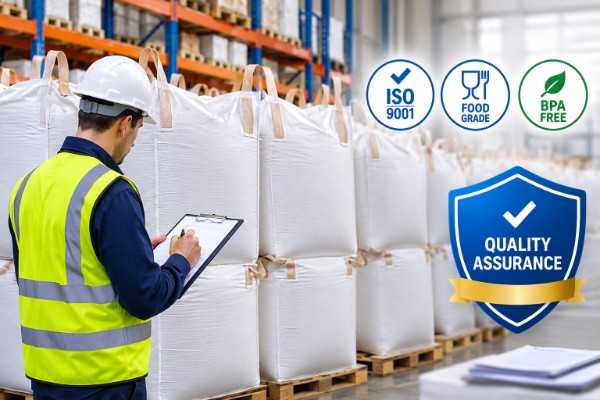
Flour, sugar, rice, and starch often move in bulk before they reach a shelf. For a food business, the bag holding them is more than packaging. It sits right against the product, so buyers want to know who made it, where it was made, and how it was checked.
Food applications call for tight control over cleanliness, material quality and consistency. Australian producers who handle ingredients in bulk therefore look closely at the supplier behind each bag. Certifications, documented policies and clear production checks give them a dependable way to compare options and approve a supplier with confidence.
That is why paperwork matters almost as much as strength. This post explains how Wales Industries handles quality assurance and certification for its food-grade bulk bags, and what Australian buyers can look for.
FIBC stands for Flexible Intermediate Bulk Container. Most people call them bulk bags or big bags. Wales Industries makes food-grade versions for the safe handling, storage, and transport of food ingredients and agricultural produce.
According to Wales Industries, these bags are used for:
Wales Industries Australia has made FIBC bulk bags since 2016 and has more than ten years of experience. It looks after the Australian and New Zealand side of the business. Here are the figures the company publishes:
The short answer is that Wales has a BRC certificate. The company says its food-grade bulk bags are made in BRC-certified facilities that meet GFSI requirements. BRC is a recognised food safety standard, and the certificate is something a buyer can ask to see.
The Quality and Certifications also lists a group of standards under the heading “Requirements for Food Grade Bags”:
General FIBC standards sit on the same page. These include ISO 21898 for non-hazardous goods, ISO 13934-1 for the tensile strength of fabric and tape, ISO 9001 for quality management, and AS 3668-1989 for non-dangerous goods. The company also states that its food-grade bags comply with GFSI guidelines, FDA food contact requirements, and HACCP protocols.
Yes, Wales has a food grade declaration available, which sits alongside the BRC certificate as part of its food safety documentation.
The material claims on the Wales website are worth reading alongside it. All food-grade FIBC bags are made from 100% virgin polypropylene resin that complies with FDA food contact standards. The company also says its raw materials comply with US FDA and US Pharmacopeia standards.
Yes, Wales has an allergen policy in place. Allergens are a serious matter in food supply, so it is a point food buyers will want covered.
Apart from the policy, the Wales site describes contamination controls built into production. Each bag goes through controlled manufacturing steps that include air washing, metal detection, light inspection, and vacuum cleaning. The company says these steps reduce contamination risks and keep quality consistent.
Wales says strict process controls and quality checks are applied at every production stage. The company lists these advantages for its food-grade range:
Liners are part of the picture too. Food grade bags can be supplied with LDPE, LLDPE or foil liners, which are inserted and shaped to fit the size of the bag. Wales can also customise dimensions, lifting loops and discharge options to suit a customer’s filling and handling setup.
The food grade product range includes 1- and 2-loop FIBC, 4-loop bulk bags, baffle bags, container liners and PP woven sacks.
Wales says it carries out detailed product tests in its own in-house laboratory, and it keeps a close watch on up-to-date industry standards. The tests it lists are:
Wales Industries Australia supplies customers across Australia and New Zealand. On the Australian side, the company names Sydney, Melbourne, Brisbane, North Queensland, Perth, Adelaide and Hobart. These sit across New South Wales, Victoria, Queensland, Western Australia, South Australia and Tasmania.
The wider Wales group has a network that spans Australia, China, India and New Zealand. The group regularly exports to 20 countries.
The company also says it holds over 50 types of FIBC bulk bags in stock, with same-day shipping from warehouses across Australia. That figure covers its FIBC range in general, not only the food-grade bags, so buyers should check availability for the specific bag they need.
Yes, the company says they are made in BRC-certified facilities that meet GFSI requirements.
A BRC certificate, a food-grade declaration, and an allergen policy.
Through air washing, metal detection, light inspection, and vacuum cleaning, with light inspection carried out on every single bag.
Food buyers need two things from a bulk bag. It has to be strong, and it has to be safe for the product inside. Wales Industries backs both with a clear set of quality measures, starting with a BRC certificate and food-grade bags made in BRC-certified facilities. A food-grade declaration is available, and an allergen policy is in place.
The bags themselves are made from 100% virgin polypropylene resin that complies with FDA food contact standards. Air washing, metal detection, light inspection, and vacuuming are part of production, and testing is carried out in the company’s in-house laboratory. Together, these steps give Australian food businesses a clear picture of how their bulk bags are made and checked.
If you want to see the BRC certificate, the food-grade declaration, or the allergen policy, or you need help choosing the right food-grade bulk bag, reach out to the Wales Industries team.
Australia
 中国 (China)