1300 786 560
 Australia
Australia
Australia
Bulk bags carry a lot of Australia’s dry materials. Sand on a building site. Fertiliser on a farm. Chemical powders in a factory. They are also called FIBCs or big bags, and from the outside they look much the same. They are not.
A bag that is too small wastes trips. A bag with the wrong load rating can be a real risk once it is lifted. That is why you should settle on size and Safe Working Load (SWL) before you place an order, not after the first delivery arrives.
This guide covers what SWL means, how safety factors work, and what to think about when you pick a size.
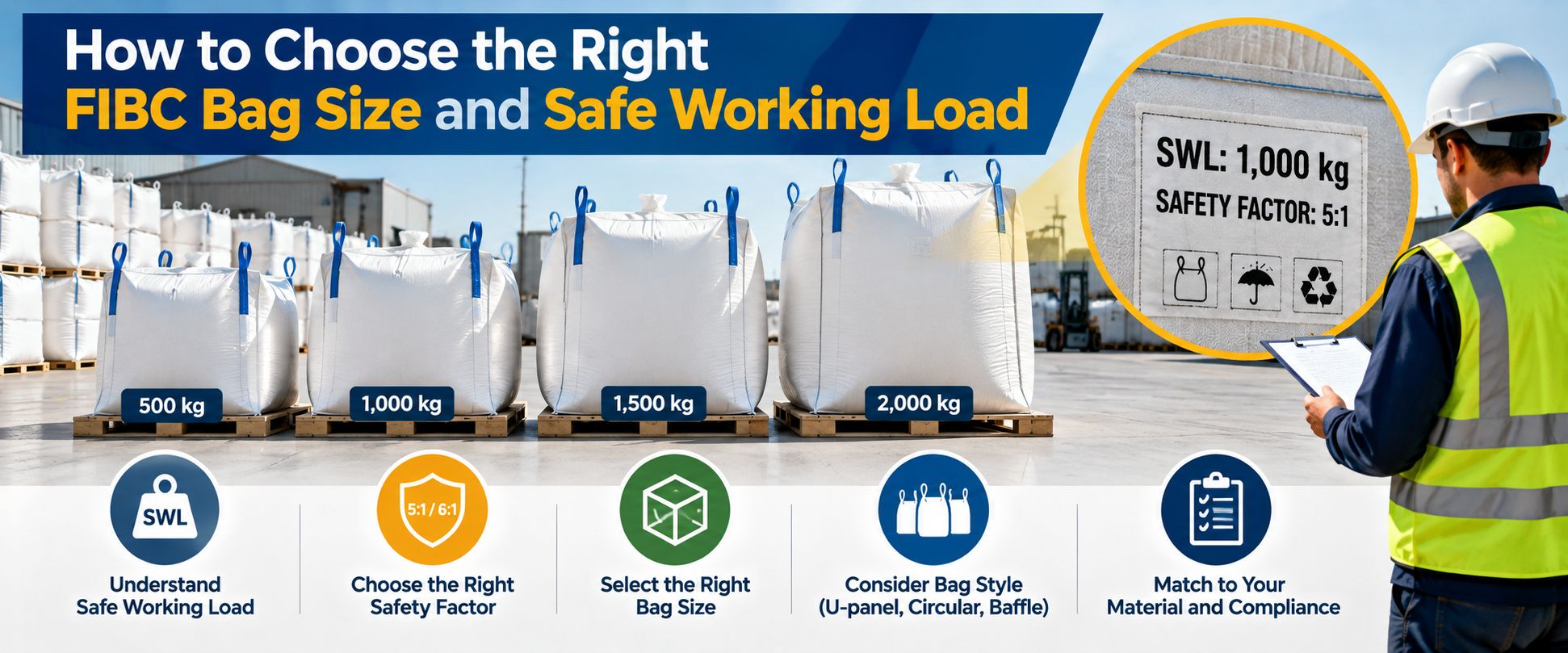
SWL stands for Safe Working Load. It is the weight a bulk bag is rated to carry. Every FIBC has one, and it is the first number to look at when you compare bags.
Most buyers focus on size, load capacity and cost. Those all matter. But SWL is the figure that ties them together, because it describes what the bag has been built and tested to hold. Wales Industries tests its bags in-house, and the tests include a cyclic top lift and load to failure test.
The SWL should be printed on the bag, along with the safety factor ratio. Wales says both numbers belong there, so check for them before you fill. Together they tell you how much the bag is rated to carry and how it was tested.
SWL is also not the same for every bag. Wales bulk bags cover a range of 500 kg to 2,000 kg, and the exact range changes with the bag style and the safety factor. The sections below show how.
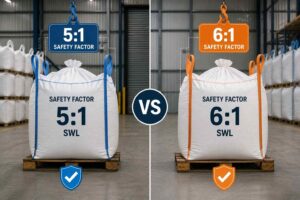
The safety factor is the ratio between a bag’s tested break strength and its SWL. Take a bag with a 1,000 kg SWL. At 5:1, it has been tested to 5,000 kg. At 6:1, the same bag has been tested to 6,000 kg.
Wales describes the two ratings this way:
5:1: single-trip use with non-hazardous dry bulk in normal industrial applications.
6:1: multi-trip use, heavier or unstable loads, and demanding conditions.
Wales bulk bags cover an SWL range of 500 kg to 2,000 kg. The exact range depends on the bag style and the safety factor.
4-loop bags: 500 to 2,000 kg at 5:1 (single trip), and 500 to 1,500 kg at 6:1 (multi-trip).
Baffle bags: 500 to 1,800 kg at 5:1 (single trip), and 500 to 1,500 kg at 6:1 (multi-trip).
Ventilated bags: 500 to 1,500 kg, with 5:1 for single trip and 6:1 for multi trip.
Read the ranges against your own load. A 1,800 kg fill, for example, sits outside the 6:1 range listed for these styles.
Size is not only about weight. Wales builds its bags around three things: load capacity, material type and compliance requirements. Each bag can be customised in size, fabric type and lifting loop setup.
Think through these points before you order:
The weight you plan to fill: This sets the SWL you need.
The material itself: Wales’ guide for lime and limestone names 90 x 90 x 120 cm with a 1,250 kg SWL as the most popular size for lime powder. Your material may call for something different.
Single- or multi-trip use: This points you to 5:1 or 6:1.
Moisture: Standard bulk bags are not watertight, but lamination, coatings and liners improve moisture resistance. PE and aluminium inner liners are available.
Filling and emptying: Bags come with various top and bottom options, including filling and discharge spouts.
Compliance: Food contact, static control and dangerous goods each need their own type of bag.
Yes, the bag shape matters as it affects how a bag stands once it is full.
U-panel bags are made from three pieces of fabric. Wales says they give the best value for businesses balancing cost and function.
Circular bags are seamless. Their shape holds less well, and the top is prone to bulging once filled.
Baffle bags have four extra fabric panels sewn across the corners. The sides stay straight, and the bag keeps a square shape. Wales states they offer 30% more storage than standard FIBC bags.
Some materials need a bag built for the risk.
UN-certified FIBC: tested and approved under United Nations regulations for hazardous and dangerous goods. Transport of dangerous goods falls under ADR/RID/IMDG-Code.
Conductive bags: Wales notes that Type C bags with anti-static properties help reduce dust explosion risk with fine powders such as limestone powder. IEC 61340 is the listed standard for static protective bags.
Food grade bags: Wales offers BRC and HACCP food grade FIBC bags, and lists ISO 22000 and BRC-S&D as its food safety standards.
The FIBC range covers a few main styles so that you can match the bag to the load, the material and the compliance rules.
4-loop bulk bags, in U-shaped or circular designs
Ventilated bags, used for goods such as potatoes, onions, nuts and wood
Wales also supplies bulk bag liners and container liners.
Wales says testing is carried out in-house. The tests listed on its Quality and Certifications page include:
Cyclic top lift and load to failure
Topple
Drop
Stacking
Sifting
Tear
Standards listed include ISO 21898 for non-hazardous goods, AS 3668-1989, and ISO 9001 for quality management.
Wales offers SWL range from 500 kg to 2,000 kg, depending on bag style and safety factor.
Yes, size, fabric type and lifting loop configuration can all be customised. Other options include liners, coatings, discharge spouts, baffles, UN certification and custom printing.
Over 50 types of FIBCs are in stock, with same-day shipping from warehouses across Australia.
Wales Industries Australia looks after Australia and New Zealand. Customers include businesses in Sydney, Melbourne, Brisbane, North Queensland, Perth, Adelaide and Hobart. The wider Wales group supplies 20 countries.
Start with the weight you plan to fill, then match it to an SWL. Choose 5:1 for single trips or 6:1 for multi-trip use. Check that the size suits your material, and pick a bag type that fits any food, static or dangerous goods rules.
Wales Industries has been supplying FIBC bulk bags in Australia since 2016, and its team can help you settle the details.
To talk through your material, fill weight and handling needs, contact Wales Industries:
Email: sales@walesindustries.com.au
Phone: 1300 786 560
Queensland: 0424 415316
Victoria: Unit 2, 139 Beverley Street, Doncaster East, VIC 3109
Queensland office: 101 Kingman Street, Sunnybank Hills, Qld 4109
Australia
 中国 (China)