1300 786 560
 Australia
Australia
Australia
Space is one of the highest costs in bulk handling. A warehouse has only so much floor area and stack height. A truck or shipping container has a fixed volume. When products like flour, fertiliser, or chemicals move in large bags, the shape of each bag decides how well that space gets used.
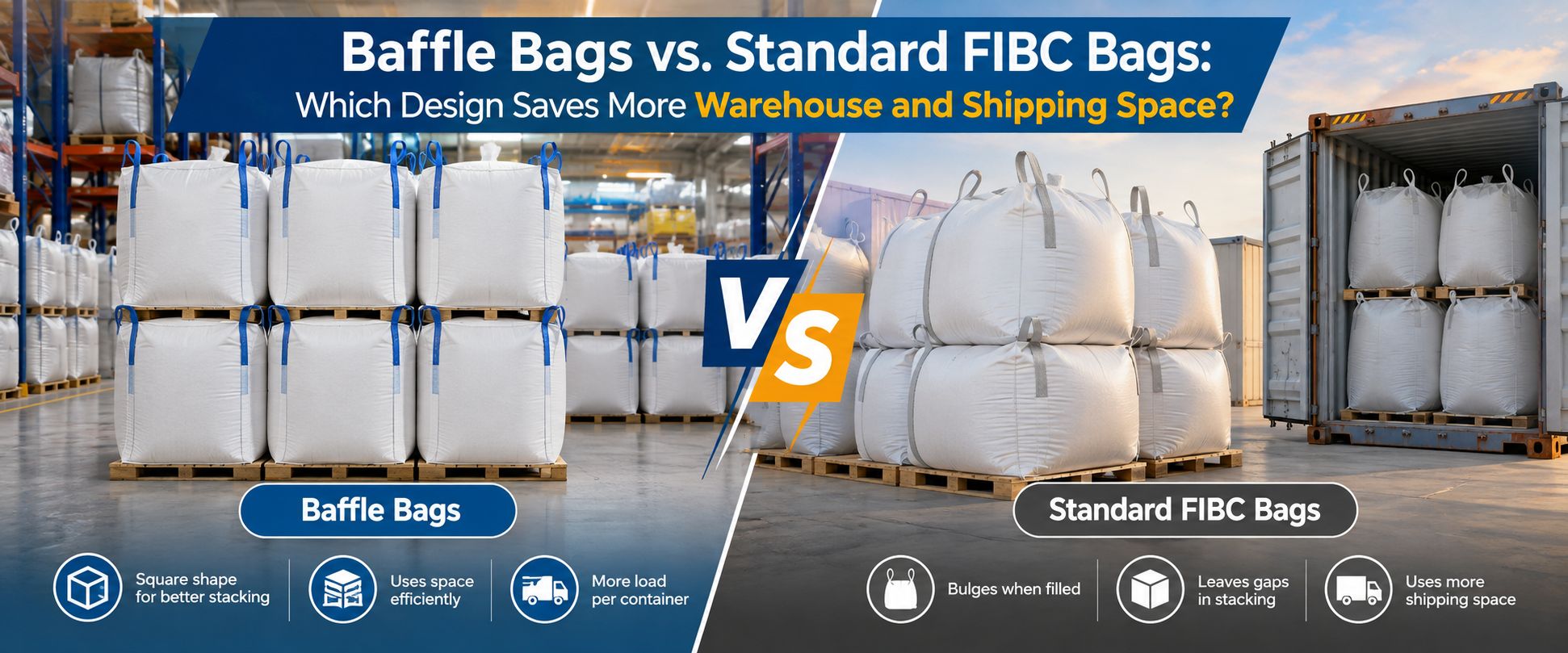
A bag that bulges wastes room. A bag that holds a square shape uses it. That simple difference sits behind a common buyer question: should you choose a baffle bag or a standard FIBC bag?
This post compares the two designs so you can match the bag to your storage and shipping needs.
FIBC stands for Flexible Intermediate Bulk Container. People also call it a bulk bag, big bag, or jumbo bag. The standard 4-loop FIBC usually comes in a U-shape or a circular shape, and in many sizes. It offers better storage and transport than traditional woven sacks.
Wales Industries’ standard 4-loop bags include these features:
The trade-off is shape. Standard bags bulge once they are full. That makes stacking harder and leaves gaps between bags.
A baffle bag is a type of FIBC. It is also called a Q bag or a baffle FIBC bag. Inside the bag, fabric panels called baffles are sewn across the corners. When the bag is filled, the baffles stop the sides from bulging out or falling over. The bag keeps a straight, square shape in storage and in transport.
Wales Industries’ baffle bags come in certified and food-grade options. They can be customised, and they are widely used in the food, chemical, and agricultural industries.
Below is a quick comparison between baffle bags and standard FIBC bags:
Baffle bags hold their shape, so they stack more neatly. Neater stacks make better use of the storage area you already have. Because of this, baffle bags can reduce the need for extra storage facilities.
The same square shape helps with trucks and containers. Baffle bags stack more efficiently in trucks, containers, and warehouses. They also help you make better use of container space and reduce overall freight costs.
A baffle bag can carry up to 30% more material than a standard FIBC. The reason is the design. Material flows evenly into all four corners, so the bag fills out fully instead of rounding off.
Here is what the baffle design adds:
“Standard” covers more than one bag style. Here is how three common constructions compare on stacking:
Each has a place. Circular bags work well when cost is the main concern and shape is not critical. U-panel bags give the best value for businesses balancing cost and function. If you need better shape retention for stacking into containers or warehouses, 4-panel bags will help.
The answer depends on how you store and ship. A baffle bag is usually the better fit when:
A standard bag is usually enough when:
Space is only part of the decision. The bag also has to be safe and suitable for the product. Wales Industries’ 4-loop range includes:
Wales Industries also makes food- and pharma grade bulk bags in BRC certified facilities.
Yes, baffle bags keep a square shape when filled, so they stack better and use storage and container space more efficiently. Standard bags bulge.
A baffle bag can hold up to 30% more material than a standard FIBC.
Yes, baffle bags come in certified and food-grade options.
Industries that use baffle bags include the food, chemical, and agricultural industries.
Wales Industries Australia looks after Australia and New Zealand. The wider Wales group regularly supplies products to 20 countries. It has production and R&D sites in 6 locations across Asia and 4 sales and service locations in the Asia-Pacific region.
Choosing between a baffle bag and a standard bag is the first step. The details of the bag matter too. Both designs can be made to suit your product and your equipment. Options include:
Think about how the bag will be filled, stacked, moved, and emptied before you order. A bag that suits filling line and your forklifts saves time as well as space.
Standard FIBC bags are reliable and widely used. Their weak point is bulging, which wastes space once the bags are full. Baffle bags fix that with internal baffles that keep the bag square. The result is neater stacking, better use of warehouse and container space, lower freight cost, and up to 30% more material per bag.
If cost is your main concern and shape is not critical, a standard bag can do the job. If space is tight or freight is a large part of costs, a baffle bag is worth a close look.
Australia
 中国 (China)