1300 786 560
 Australia
Australia
Australia
Dry bulk materials move through agriculture, construction, food processing, and chemical handling, and much of it travels in FIBC bulk bags. Some people call them big bags. Every bag has to be filled, lifted, stored, and emptied, and its design needs to suit each of these steps.
The top and bottom matter more than many buyers expect. They decide how the product goes in and how it comes out. A bag that doesn’t fit your process can cost you time and money.
This guide covers the filling and discharge options Wales Industries lists for its FIBC range, and how to match them to your job.
FIBC stands for Flexible Intermediate Bulk Container. Wales Industries manufactures them from woven polypropylene. The top of the bag is where it gets filled. The bottom is where it gets emptied, which is called discharge.
On its product pages, Wales Industries lists top and bottom construction options and says bags can be customised for both filling and discharge.
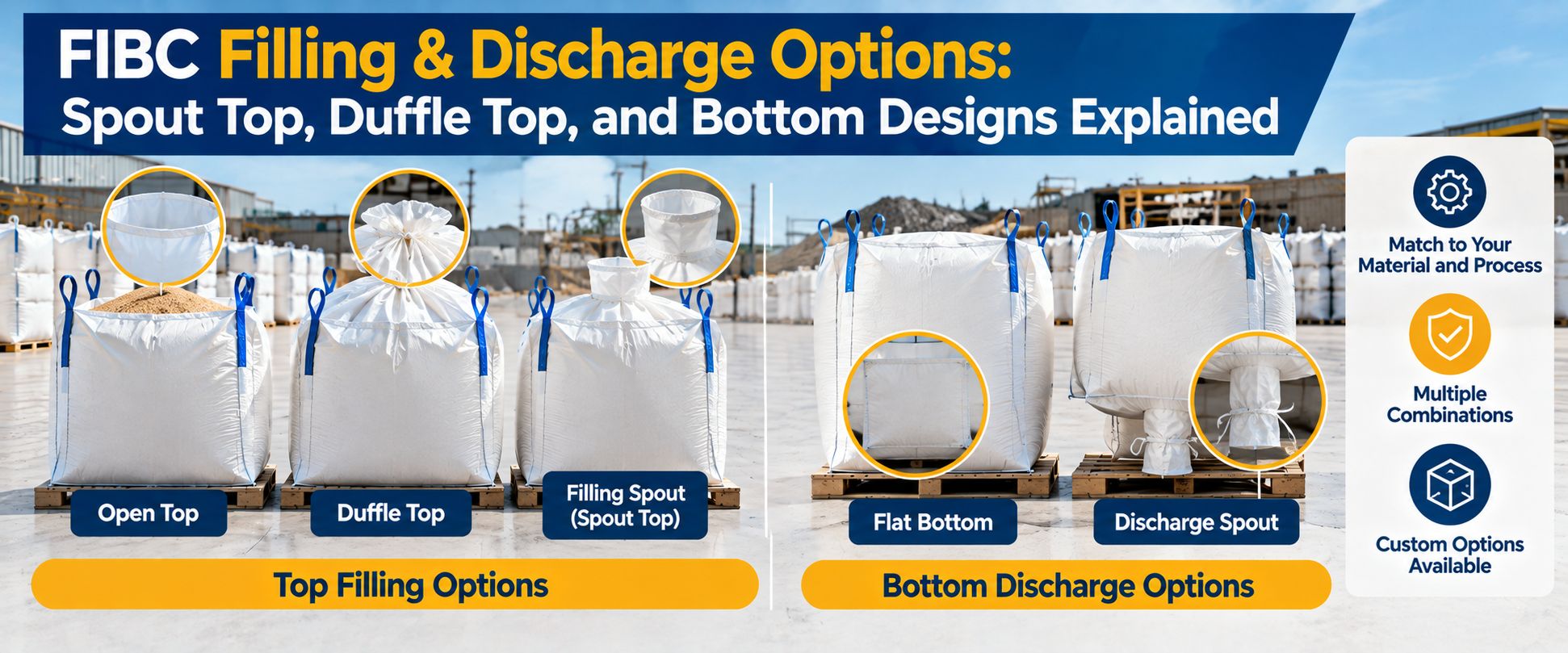
Wales Industries offers three tops: open top, duffle top, and filling spout (the spout top). It offers two bottoms: flat bottom and discharge spout. Any top can pair with either bottom. That gives the six combinations shown on the 4-loop and baffle bag pages:
Open top and flat bottom
Duffle top and flat bottom
Filling spout and flat bottom
Open top and discharge spout
Duffle top and discharge spout
Filling spout and discharge spout
The baffle bag page also mentions full bottom discharge, alongside discharge spouts and flat bases.
Each product page words it a little differently, so here is what they say. Here are different bag options offered by Wales Industries:
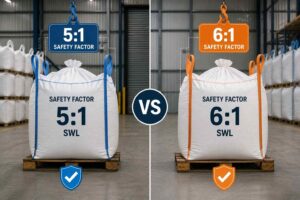
4 loop bulk bags: All six combinations are shown. Safe working load (SWL), the most weight a bag is rated to carry, runs from 500 kg to 2000 kg. Single-trip bags have a 5:1 safety factor and go up to 2000 kg. Multi-trip bags are 6:1 and go up to 1500 kg.
Baffle bags: The same six combinations appear, with SWL from 500 kg to 1800 kg. Wales Industries says these bags are commonly used in automated and semi-automated filling lines.
1 & 2 loop bags: Various top and bottom options are available, with SWL from 500 kg to 1500 kg. Filling options can be customised.
Conductive (Type C) bags: These can be made with different discharge options and still keep their conductive properties. They must be properly grounded during filling and discharge.
UN certified bags: Discharge designs can be customised, as long as every change meets UN testing and certification rules.
Wales Industries tailors FIBC bags to load capacity, material type, and compliance requirements. Those three points are a good place to start. These questions help you work through them.
What are you packing? The 4-loop page lists typical contents such as grain, flour, cement, fertiliser, chemicals, and pet food.
Will the bag be used once, or more than once? Single-trip bags are 5:1. Multi-trip bags are 6:1. Learn more about FIBC safety factors.
Does the product need protection from moisture or contamination? 4-loop bags can have PE or aluminium inner liners. Learn more about bulk bag moisture protection.
Is static a risk? A Type C conductive bag is made for this, but it needs a proper ground connection.
Are you handling dangerous goods? UN-certified bags are made for hazardous materials. Any custom discharge design still has to meet UN rules.
Do you fill on an automated line? Baffle bags are commonly used on these.
Wales Industries Australia has supplied FIBC bulk bags since 2016. It serves more than 500 customers and supplies 1.5 million products each year. Over 50 types of FIBC are available from stock, with same-day shipping from warehouses across Australia.
Testing happens in the company’s own laboratory. It includes cyclic top lift, drop, topple, and stacking tests. The quality page lists ISO 21898, AS 3668-1989 and ISO 9001 among its standards.
For more information, read about FIBC bulk bag testing.
Yes, Wales Industries says baffle bags can be made with discharge spouts, full bottom discharge or flat bases, depending on how the bag will be unloaded.
Wales Industries Australia looks after Australia and New Zealand. The wider group regularly supplies 20 countries. It has production and R&D sites in 6 locations across Asia.
Wales Industries tests them in its own laboratories. The tests are then repeated at an independent facility for official certification.
Yes, conductive bags can be customized. Sizes, lifting loops, liners, discharge options and printing can all be changed while the bag stays conductive.
The safe working load is 500 kg to 2000 kg on 4-loop bags and 500 kg to 1800 kg on baffle bags. On 1 & 2 loop bags, it is 500 kg to 1500 kg.
Yes, the 4-loop, baffle, and 1 & 2 loop pages all list 4-colour printing.
FIBC bags are filled at the top and emptied at the bottom, so those two ends deserve as much thought as the load rating. Wales Industries offers open top, duffle top, and filling spout tops, with flat bottom or discharge spout bottoms.
Match your choice to your product, your trip count, and the way you fill. If static or dangerous goods are involved, go with Type C or UN-certified and keep any changes within their rules.
Not sure which top and bottom suit your product? Contact the Wales Industries team to talk through the right filling and discharge setup for your bags and to request a quote.
Australia
 中国 (China)