1300 786 560
 Australia
Australia
Grain, cement, fertiliser, minerals and chemicals share one thing. They often travel in large woven bags instead of small sacks or drums. These bags are called FIBCs, short for flexible intermediate bulk containers. You will also hear them called big bags or bulk bags.
Most people only see the finished bag sitting on a pallet. Few stop to ask how it got there. A bag that holds hundreds of kilograms has to be built with care, from the first plastic tape to the last stitch.
This post walks through that journey, using what Wales Industries shares about its own products, testing, and supply network.
An FIBC is a flexible container made from woven polypropylene. Polypropylene, often shortened to PP, is a tough plastic. Once it is woven into fabric, it gives the bag its strength and keeps the load stable during filling, lifting, and discharge.
Wales Industries makes these bags for construction, agriculture, food processing and chemical handling, among other sectors. The bags are also built to suit automated filling and handling systems.
Wales Industries describes the basic route in a few stages. What separates a reliable bag from a weak one is the quality control behind the process.
The fabric in Wales FIBCs is UV-stabilised woven polypropylene. Water resistance comes from either lamination or a polyethylene liner. Inner liners can also be made from PE or aluminium. Wales says these optional liners add moisture protection, contamination control and product safety.
Two bags can start from the same fabric and still turn out very different. The build decides how the bag is lifted, how it holds its shape, and how much it can carry.
These bags are made from a single tubular fabric. The body fabric extends up into the lifting loop. That gives the bag a higher breaking strength and makes it easier to lift. Wales lists a safe working load (SWL) of 500 kg to 1500 kg. Loops can be wrapped in coloured sleeves, which helps staff tell different bags apart.
The four loop bag is the traditional shape, built in a U-shaped or circular design. Wales lists an SWL range of 500 kg to 2000 kg. The bags can be customised in size, fabric type, and lifting loop setup.
Baffle bags, also called Q bags, have four extra fabric panels sewn across the four corners. When the bag is filled, those panels stop the sides from bulging. The bag keeps a straight, square shape. Wales says this design can hold up to 30% more material than a standard FIBC. It also stays within pallet dimensions when filled, which can mean fewer pallets and lower freight costs.
Wales offers several top and bottom options:
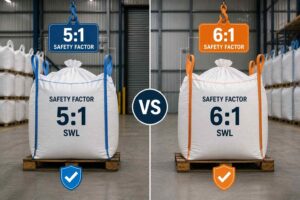
The safety factor is the other big choice. For 4-loop bags, Wales lists two main setups:
Some goods are hazardous. For those, Wales makes UN-certified bags. They follow the United Nations Recommendations on the Transport of Dangerous Goods, known as the Orange Book. They are tested for road (ADR), rail (RID), and marine (IMDG Code) transport.
Wales names four types of UN FIBC made from woven plastic:
UN bags are not rated by the 5:1 or 6:1 safety factor. They are sorted by packing group I, II, or III instead, based on the hazard level of the contents.
Some powders react badly to static. Type C bags are made from non-conductive polypropylene fabric interwoven with conductive threads, normally sewn in a grid pattern.
The threads connect the bag to the ground through a grounding point. Wales is clear on one point: do not use these bags if the ground connection is missing or damaged.
Wales carries out product tests in its own in-house laboratory. The list includes:
UN bags go one step further. They are tested in Wales’ own laboratories first. The tests are then repeated at an independent testing facility, and the results are the basis for a unique UN number.
Wales also lists the standards it works to, including ISO 21898 for non-hazardous goods, ISO 9001 for quality management and AS 3668-1989 for non-dangerous goods. For food-grade bags, it lists BRC-S&D and ISO 22000. For static protective bags, it lists IEC 61340.
Wales Industries Australia has been manufacturing FIBC bulk bags since 2016. It is part of a wider group with a network across Australia, China, India and New Zealand.
The group has production and R&D sites in six locations across Asia and four sales and service locations in the Asia-Pacific region. Wales Industries Australia looks after Australia and New Zealand.
The figures Wales shares:
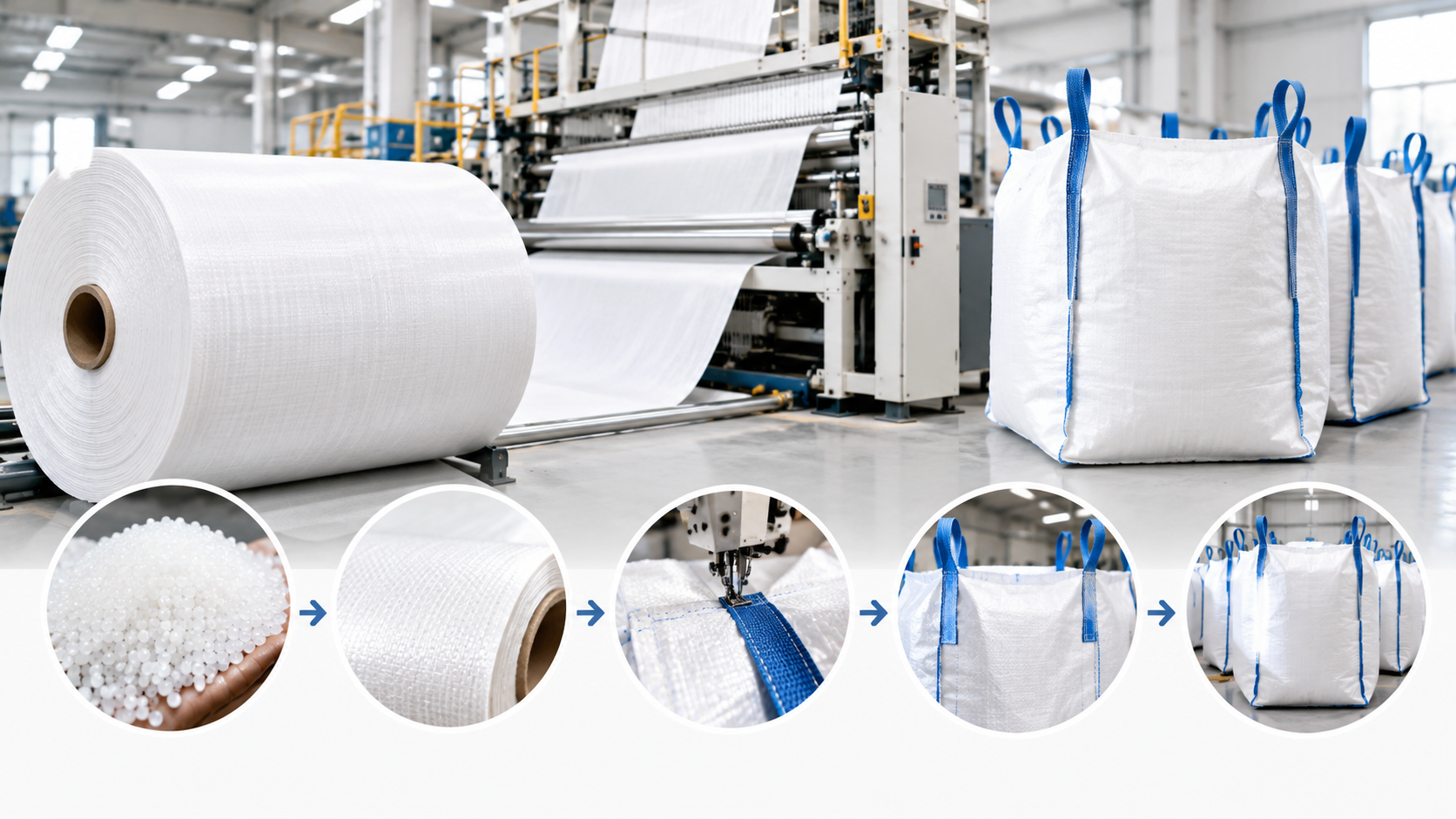
It is made from woven polypropylene. Resin is extruded into thin tapes, woven into fabric, then cut, printed and sewn.
The Wales group regularly exports to 20 countries around the world. Wales Industries Australia supplies Australia and New Zealand.
Yes, product tests are carried out in its in-house laboratory. UN bags are also tested again at an independent facility.
For 4 loop bags, Wales lists 5:1 as single trip and 6:1 as multi trip.
A bulk bag starts as polypropylene resin. It becomes tape, then fabric, then a finished bag with the loops, liners, spouts, and printing the job needs. Baffle, UN-certified, and conductive builds add features for stability, hazardous goods, and static control. Wales backs the range with tests run in its own in-house laboratory.
If you are planning a bulk bag order, or are not sure which build suits your product, talk to the Wales Industries team. They can help you match the bag to the load, the material, and your industry.
Australia
 中国 (China)