1300 786 560
 Australia
Australia
Cement, flour, fertiliser and resin have one thing in common. They are dry, fine, and easy to spill. Moving them in bulk takes a bag that stays shut, holds its shape and survives a tall pallet stack. When a bag fails, the cost is spilled product, damaged stock and lost time.
Construction, food and chemicals all depend on this kind of packaging every day. A cement plant, a flour mill and a chemical supplier each need bags that arrive intact, whatever the road or the weather throws at them. That is why the way a bag is made matters almost as much as what goes inside it.
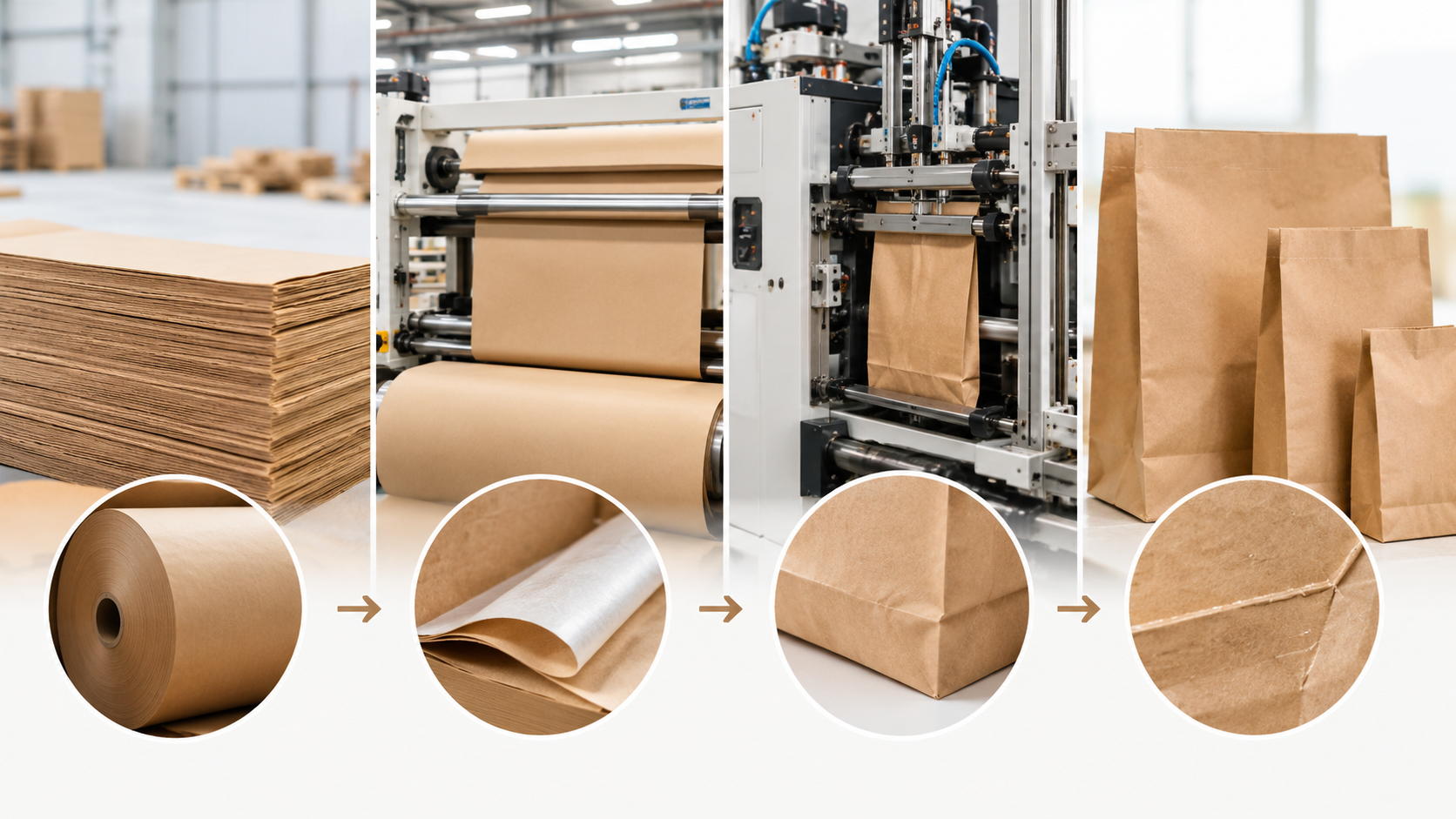
Paper sacks have handled this job for a long time. They look simple from the outside, but a good one is built with care. This post walks through how a multi-wall paper bag comes together, which choices change the final bag, and what to check before you order.
“Multi-wall” means the bag has more than one layer. Instead of a single sheet, the sack is made from several layers of kraft paper. Many also have a plastic film or coating between the layers.
Each layer adds strength. Together, they resist punctures, tears, and rough handling far better than a single-ply bag. Wales Industries also calls these bags block bottom bags or valve paper bags, because of their flat base and filling style.
Quick answer: A multi-wall paper bag is built from several layers of kraft paper, often with a liner or coating, a flat base, and a closure suited to the filling method.
A multi-wall paper bag is a set of choices that work together. The layers, the liner, the base, the top, and the print all change how the bag handles the product inside. Here is how each part fits in.
A well-specified sack uses two to four layers of kraft paper. The number depends on the weight of the product inside. One layer might add strength while another helps block moisture.
Moisture is the biggest risk for products like cement and flour. A plain paper bag with no liner is the weaker choice. Wales Industries offers lamination or a polyethylene liner, so a bag can be made air-tight or water-tight. For food products, the inner layer should resist moisture without adding any odour or taste.
The base is what gives this bag its name in many catalogues. A flat, block-shaped bottom lets the filled bag stand upright. That helps in three ways:
The top depends on how the bag is filled. Two common styles are:
Wales Industries offers printing in up to eight colours. The surface can carry branding, batch codes, ingredient lists and allergen warnings.
Wales Industries states that its paper bag production line is imported from Germany and runs as a fully automatic line.
The company’s paper bag brochure groups its range into four series:
Bags come in a wide range of sizes and thicknesses. They can also be customised with different materials, coatings, liners, valve options and printing to suit the product and the brand.
Wales Industries carries out product tests in its in-house laboratory. The tests named on its site include:
The sifting test matters most for powders. It checks whether a bag design keeps fine material from escaping through seams or fabric.
The company also lists ISO 9001, the international standard for quality management systems, among its standards. For food-grade sacks, it says production takes place in facilities certified to the BRCGS Packaging Materials standard. It also says raw materials and production batches are recorded, so a question about a batch can be traced.
According to Wales Industries, typical contents include:
Yes. Wales Industries says its bags suit fully automatic and semi-automatic filling lines. The consistent shape and stable base help the line run smoothly.
Yes, size, thickness, colour, lamination, liner, valve option, and print can all be matched to the product.
They can, when made with the right materials and coatings. A polyethylene liner or lamination is the option to ask about for damp-sensitive products.
Wales Industries Australia looks after customers across Australia and New Zealand. The wider group regularly exports to 20 countries. Its global network spans Australia, China, India and New Zealand. It has production and R&D sites in six locations across Asia, and four sales and service locations in the Asia-Pacific region.
In Australia, the company names customers in Sydney, Melbourne, Brisbane, North Queensland, Perth, Adelaide and Hobart. It also states that its warehouses across the country can offer same-day shipping.
Wales Industries Australia has manufactured FIBC bulk bags and paper bags since 2016. Across its range, the company supplies about 1.5 million products a year and has served more than 500 customers.
A multi-wall paper bag is more than folded paper. It is several layers of kraft paper, often with a liner or coating, a flat base for stable stacking, and a top that suits the filling method. Printing, size, and thickness can then be set to match the product.
The key points to take away:
If you are choosing a paper bag for cement, flour, resin, feed or fertiliser, talk to the Wales Industries team. Share your product, bag weight, and filling line, and they can help you find the right bag.
Australia
 中国 (China)