1300 786 560
 Australia
Australia
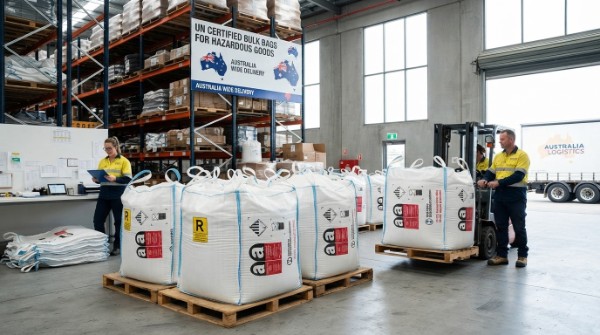
Transporting hazardous goods carries responsibilities that ordinary freight does not. Flammable solids, toxic powders, pesticides, and other regulated chemicals must be packed in containers that have been tested against the demands of road, rail, and sea transport.
A packaging failure can mean lost product, damaged equipment, and risk to the people who handle the load. For large volumes of dry material, businesses can use a UN-certified FIBC, also known as a UN-certified bulk bag. FIBC stands for Flexible Intermediate Bulk Container.
This guide explains what the UN marking means, how these bags are tested, and what buyers should confirm before purchasing in Australia.
A UN-certified FIBC is a bulk container tested and approved under United Nations regulations for the safe transport of hazardous goods.
Wales Industries describes these bags as being made for carrying hazardous or potentially hazardous substances. They follow the United States Recommendations on the Transportation of Dangerous Goods, better known as the Orange Book.
They are also tested for three kinds of support:
Every UN bag has to pass a set of tests. Wales Industries lists six:
The first round happens in Wales’ own testing laboratories. The tests are then repeated at an independent testing facility, and that is how the bag is officially certified. Those results are the basis for issuing a unique UN number. From there, UN-rated bags are made fully to the UN regulations.
For a buyer, this is the part worth remembering. A UN bag has been tested twice, once by the maker and once by an outside party.
Wales lists four types of FIBC for dangerous goods made from woven plastics:
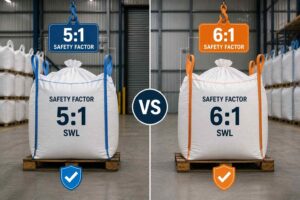
You may have heard of a 6:1 safety factor for bulk bags. Wales explains that it applies only to FIBCs for non-dangerous goods. UN bags are not classified that way. The company also notes that all UN big bags are treated as multi-trip bags, even without that 6:1 figure. They are sorted by packing group instead, and the groups are I, II, and III.
Each UN FIBC carries a UN symbol. The symbol shows the hazard level of the product inside. Wales gives this breakdown:
The Wales UN page lists these as typical contents:
The same page shows bag types for hazard classes 4.1, 4.2, 4.3, 5.1, 5.2, 5.3, 8 and 9. Wales also says these bags suit hazardous chemicals, toxic powders, flammable solids, and other regulated substances covered by UN dangerous goods guidelines.
Check the bag itself. Certification is confirmed through UN markings printed on it. According to Wales, those markings include the test type, the manufacturer’s identification, and the approval code.
The UN symbol (X, Y, or Z) tells you the hazard level the bag is made for. If a supplier can’t explain the markings on a bag, treat that as a warning sign.
Customising. Yes, with one condition. Wales says UN bags can be produced in various sizes, fabrics, liners and discharge designs, as long as every change meets UN testing and certification requirements. For chemical products, the company also lists coatings and antistatic fabrics as options, depending on the application.
Reusing. It depends on the certification level and the condition of the bag. Many are designed for limited reuse, and only where regulations and the manufacturer’s guidance allow it.
Wales Industries Australia has been supplying FIBC bulk bags since 2016. UN Certified FIBC sits in its FIBC range, next to 1 & 2 loop bags, 4 loop bags, baffle bags and conductive bags.
Here is what the company says sits behind its UN bags:
ISO 9001, the international quality management standard, is listed among the standards it follows
Wales says it has served more than 500 customers. Its bulk bags have been delivered to customers in Sydney, Melbourne, Brisbane, North Queensland, Perth, Adelaide and Hobart. That covers New South Wales, Victoria, Queensland, Western Australia, South Australia and Tasmania.
The Wales group regularly exports to 20 countries. Its network spans Australia, China, India and New Zealand. It has production and R&D sites in 6 locations across Asia, and 4 sales and service locations in the Asia-Pacific region. Wales Industries Australia looks after the business for Australia and New Zealand.
A short list helps you compare suppliers. Try these:
UN-certified bulk bags are built for hazardous goods. They follow the UN Orange Book and are tested for road, rail, and sea transport. Each bag passes six tests, first in the maker’s Lab, and then at an independent facility, and the results lead to a unique UN number.
The UN symbol on the bag (X, Y, or Z) shows the hazard level, and packing groups I, II, and III replace the 6:1 safety factor used for non-dangerous goods.
When you buy in Australia, look for clear UN markings, proof of testing, and a supplier who can explain customisation limits. Wales Industries Australia offers UN-certified FIBCs with in-house testing, independent certification, and a customer base of more than 500.
Planning a UN-certified bulk bag order for hazardous goods? Talk to the Wales Industries team about your product, its packing group, and the bag you need.
Australia
 中国 (China)