1300 786 560
 Australia
Australia
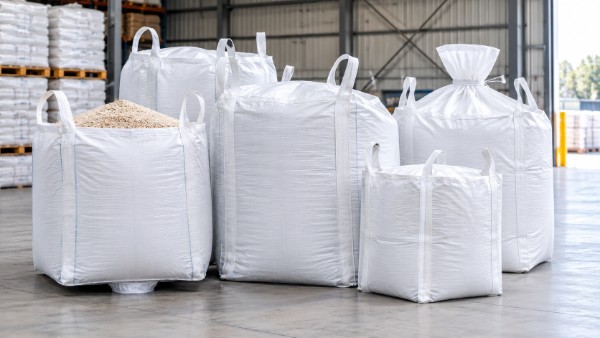
Grain, cement, fertiliser, minerals, and chemicals are commonly moved in bulk rather than in small sacks. Flexible Intermediate Bulk Containers (FIBCs), also known as big bags or bulk bags, are woven containers designed to be lifted by a forklift or crane.
Although an FIBC may appear straightforward, an incorrect specification can lead to unnecessary cost and handling problems. Confirming the requirements before placing an order helps ensure the bag suits the product and the equipment.
This guide outlines the key points to specify, using the product information published by Wales Industries.
Wales Industries describes its FIBC bulk bags as high-strength woven polypropylene containers. They are built for dry bulk materials and used across construction, agriculture, food processing, and chemical handling.
The 4-loop and baffle bags use UV-stabilised woven polypropylene fabric. For 1- and 2-loop bags, you can choose coated or uncoated fabric.
Size starts with your product and your equipment. The standard 4-loop bag comes in many sizes, usually in a U-shaped or circular design. Wales makes bags to custom sizes, so you can match the bag to your filling and handling setup.
For UN bags, size is limited by volume. The maximum depends on the hazard level of the goods.
Before you ask for a quote, have these ready:
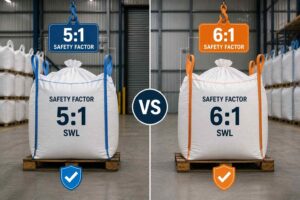
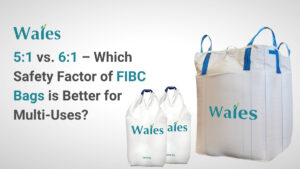
SWL stands for safe working load. It is the load range a bag is rated for. Wales lists it next to a safety factor, shown as S.F. A 5:1 factor and a 6:1 factor are both offered.
Here is how the ranges look by bag type, based on the Wales product pages.
| Bag type | SWL range |
| 1 & 2 loop
|
500 kg to 1500 kg |
| 4 loop
|
500 kg to 2000 kg |
| Baffle
|
500 kg to 1800 kg |
For both 4-loop and baffle bags, the safety factor decides which SWL range applies:
| Safety factor | SWL | Design |
| 5:1 | 500 to 2000 kg (4-loop), 500 to 1800 kg (baffle)
|
Single trip |
| 6:1 | 500 to 1500 kg
|
Multi trip |
So if you plan to reuse the bag, ask for 6:1. If it is a one-way bag, 5:1 gives you a wider SWL range.
UN-certified bags are made for hazardous or potentially hazardous goods. Wales says they follow the United Nations Recommendations on the Transport of Dangerous Goods, often called the Orange Book. They are tested for road (ADR), rail (RID) and sea (IMDG Code) transport.
One detail catches people out. UN bags are not classified by safety factor. They are classified by packing group instead. Wales explains that the 6:1 safety factor applies only to bags for non-dangerous goods.
| Hazard level | Packing group | UN symbol | Max. volume |
| High | I | X | 1.5 m³ |
| Medium | II | Y | 3 m³ |
| Low | III | Z | 3 m³ |
Wales lists four UN codes for woven plastic FIBCs:
If your product is a chemical, pesticide, pigment, or similar material, check early whether it needs a UN bag.
1 & 2 loop bags. These are made from a single tubular fabric. The body fabric extends into the lifting loop, which gives a higher breaking strength. Wales says they are more cost-effective than 4-loop bags. Loops can be wrapped in coloured sleeves, which helps you tell bags apart by use. They are used mainly in agriculture, and also for powders and minerals.
4 loop bags. This is the standard design. Four loops spread the weight and work with forklifts, cranes, and hoists. Typical contents include cement, feed, fertiliser, flour, grain, gravel, seeds and chemicals.
Baffle bags (Q bags). Four extra fabric panels are sewn across the corners. The bag keeps a square shape when filled instead of bulging. Wales says a baffle bag can hold up to 30% more material than a standard FIBC. It also stays within pallet dimensions, stacks more neatly, and can lower freight costs.
Conductive bags (Type C). These are made from non-conductive polypropylene woven with conductive threads. They must be grounded during filling and discharge. Wales states clearly that they should not be used when the ground connection is missing or damaged. Wales also publishes a chart linking dust ignition energy to the bag type needed. For dust with a minimum ignition energy below 3 mJ, the chart points to Type C or D.
Most of the choices below can be set on a custom order:
Wales tests its products in its own in-house laboratory. The tests include:
For UN bags, Wales says the tests are first run in its own laboratories. They are then repeated in an independent testing facility before a UN number can be issued.
Standards listed on the Wales quality page include:
Wales says it holds over 50 types of FIBC in stock, with same-day shipping from warehouses across Australia. It has supplied customers in Sydney, Melbourne, Brisbane, North Queensland, Perth, Adelaide and Hobart.
Before you order custom FIBC bags, settle these points:
If you want help working out the right specification, the Wales Industries team can guide you through it. Use the Contact Us or Enquire Now page on the Wales Industries website to start your enquiry.
Australia
 中国 (China)