1300 786 560
 Australia
Australia
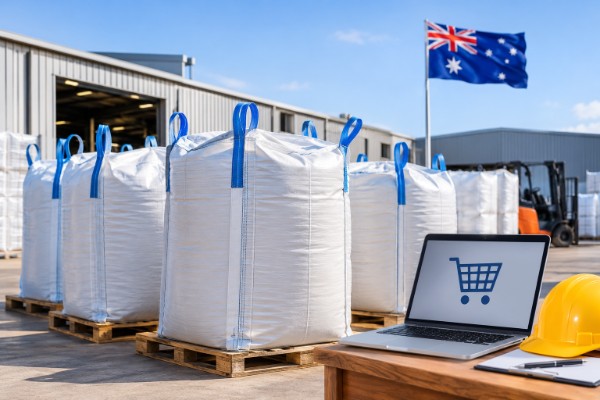
Bulk bags carry a big share of the dry goods that move around Australia. Grain leaves the farm in them. Cement, sand, fertiliser and minerals travel in them too. You will hear them called FIBCs, big bags or bulk bags. FIBC stands for flexible intermediate bulk container, and the bag itself is made from woven polypropylene.
Buying one online looks easy. Pick a size, set a quantity, place the order. But two bags that look alike can be built very differently. One may be made for a single trip and another for repeated use. One may suit flour, while another has to carry a hazardous chemical. That is why price and order size are rarely a single fixed number.
This guide explains how pricing, order quantities and custom options work at Wales Industries. It is an Australian FIBC manufacturer that has supplied bulk bags since 2016.
Three things shape a bulk bag order at Wales Industries: load capacity, material type, and compliance requirements. The company tailors its bags to each one. Pricing comes as a quote based on your job, so those three points are the best place to start when you think about cost.
Three designs are described in cost terms:
Order size is handled through the quote. The Wales enquiry form asks for your estimated quantity and when you plan to buy. Giving both up front gives the team what it needs to reply properly.
If you need standard bags quickly, stock may matter more than quantity. Wales says over 50 types of FIBC are available from stock, with same-day shipping from warehouses across Australia. For custom bags, it makes sense to confirm timing when you enquire.
Buying starts with an online enquiry. Here is the path:
Ask about samples if your bag is custom. A customer in Geelong, Victoria, says on the Wales site that he sent the same specification to three companies. He says only Wales went as far as having a sample made and tested.
Wales groups its FIBC range into these styles:
The company also supplies container liners, PP woven sacks, BOPP bags, multi-wall paper bags, mesh bags and skip bags.
Wales says size, fabric type, and lifting loop setup can all be customised. Its product pages list more options:
Coloured sleeves on 1 & 2 loop bags, so different bags are easy to tell apart
There are three tops: open top, duffle top, and filling spout. There are two bottoms: flat bottom and discharge spout. Any top can pair with either bottom, which gives six combinations. Conductive and UN bags can be customised too, as long as they keep their conductive properties or meet UN rules.
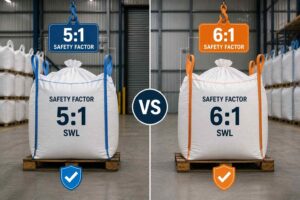
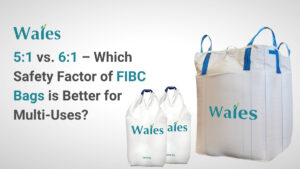
The safety factor compares a bag’s tested break strength with its SWL. A 1,000 kg bag rated 5:1 has been tested to 5,000 kg. Wales describes 5:1 as the choice for single-trip use with non-hazardous dry bulk, and 6:1 for multi-trip use or heavier, less stable loads. On 4 loop bags, 5:1 covers 500 kg to 2,000 kg, and 6:1 covers 500 kg to 1,500 kg. UN bags are different. They are classified by packing group (I, II, or III) instead of a safety factor.
Wales tests its products in its own laboratory. Its quality page lists 12 tests. They cover yarn and fabric tensile, UV, coating performance, sifting, cyclic top lift and load to failure, tear, topple, drop, stacking, breakdown voltage and grounding. UN bags are tested in Wales labs first, then the tests are repeated at an independent facility.
The standards it lists include:
Wales Industries Australia looks after Australia and New Zealand. Its site names customers in Sydney, Melbourne, Brisbane, North Queensland, Perth, Adelaide and Hobart.
The wider Wales group regularly supplies 20 countries. It has production and R&D sites in 6 locations across Asia, and 4 sales and service locations in the Asia-Pacific region. The company reports more than 500 customers and about 1.5 million products supplied each year.
Bulk bag pricing at Wales Industries is quote-based, and it follows your load, your material, and the rules your product must meet. Order quantity and timing are part of the enquiry. Custom options cover size, fabric, loops, liners, coatings, spouts and printing. The range runs from 1 & 2 loop and 4 loop bags to baffle, UN-certified and Type C bags.
Ready to price a job? Open the Enquire Now page on the Wales Industries website, describe what you are packing, and add your estimated quantity and buying date. The team will take it from there.
Australia
 中国 (China)