1300 786 560
 Australia
Australia
Think about how much of what we buy starts life in a sack. Cement for a backyard slab, flour for a bakery, seed for a farm, powder for a factory line. Each one has to get from a plant to a truck, a warehouse, and a customer without spilling, splitting, or going damp.
How a sack is built decides whether that trip goes well. Multi-wall paper sacks are one of the most common choices for powders and granules. This post looks at how they are put together, with the Wales Industries paper bag range as the example.
A multi-wall paper bag is strong packaging made from several layers of kraft paper. Some designs add plastic film or foil as well. This layered build gives the bag its strength, helps it resist tearing, and protects the contents from moisture and dirt.
You will see these bags called paper bags, valve paper bags, or block bottom bags. The flat base is what most buyers notice first, because it lets a filled bag stand upright.
Quick answer: Paper sack production covers kraft paper layers, optional barrier layers or liners, a closure style such as valve or open mouth, and printing. Wales Industries makes its bags on a fully automatic line imported from Germany and tests them in its own laboratory.
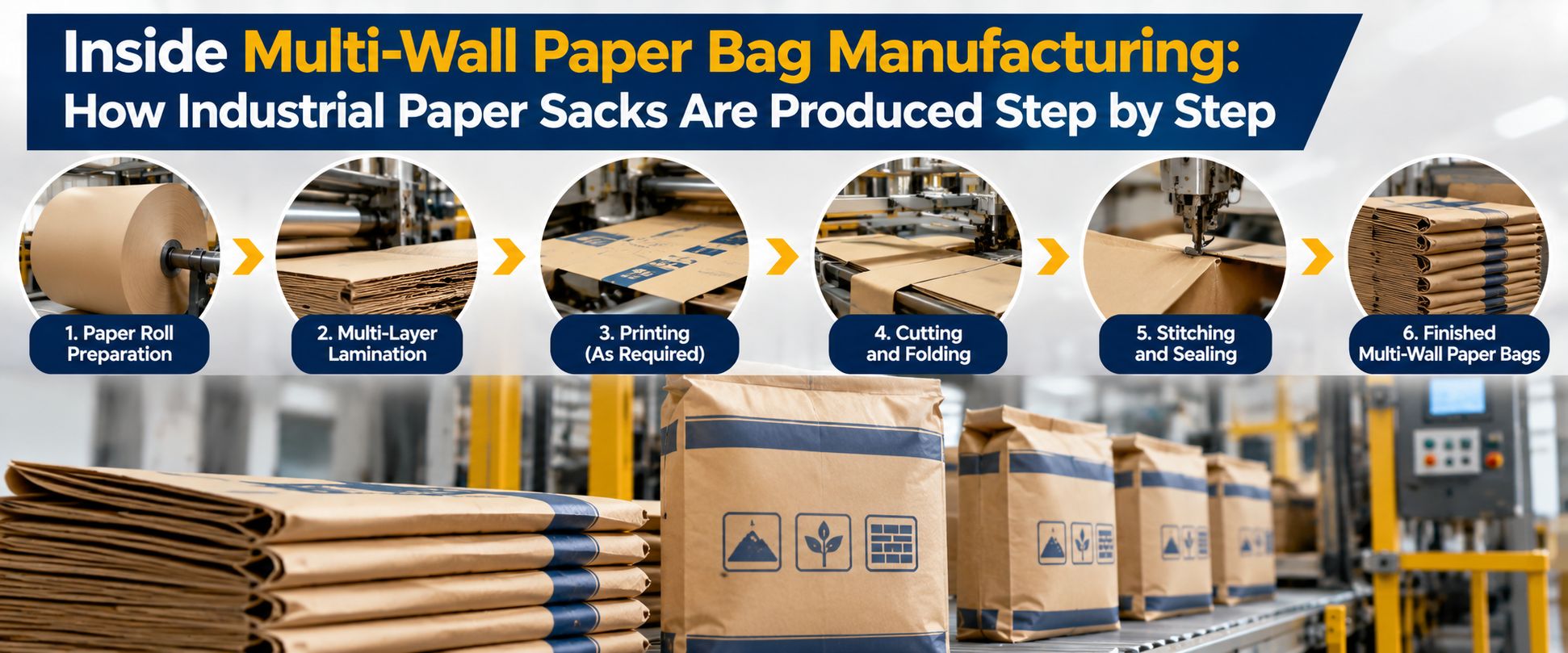
The work comes down to the steps below.
Everything starts with the paper. The goal is a good balance between flexibility and strength. Kraft paper is a renewable material, which is one reason finished paper sacks can be recycled. The bags are made in a wide range of sizes and thicknesses, so the paper can be matched to the product going inside.
Sheets of kraft paper are layered to form the bag wall. The number of layers can vary with what the sack will hold. A single-layer paper bag only suits light items, while multi-wall sacks are made for heavier, bulkier goods.
Some products need more protection from moisture or oxygen. In that case, a barrier layer such as polyethylene or aluminium can be added.
The design depends on how the bag will be filled and used. The Wales Industries paper bag range includes these styles:
Open-mouth sacks are another option. The whole top stays open during production. Product is poured or pumped in, and the top is then closed by sewing, gluing, or heat sealing. Valve bags are common for cement and flour, where dust-free, automated filling matters.
Wales Industries can make its paper bags airtight or watertight, using lamination or a polyethylene liner. The inner and outer finishes are air-resistant, moisture-proof, and recyclable.
This matters most for cement. Even a little dampness can cause clumping, and a plain paper bag without a liner is the weaker choice.
The bags can be printed in up to eight colours. That space carries branding. On food sacks, it can also hold ingredient lists, batch codes and allergen warnings.
The Wales Industries paper bag production line is imported from Germany and runs fully automatically. The finished bags suit fully or semi-automatic filling lines.
That helps high-volume producers, since filling equipment needs every bag to keep the same shape. Valve designs help here too. They allow quick, dust-free filling, which matters most for products like cement and flour.
Wales Industries tests its products in its own laboratory and keeps a close watch on up-to-date industry standards. Tests include:
The sifting test shows why this matters for powders. It checks how well a bag design holds fine or powdered material without letting it escape.
Quality work also follows ISO 9001, the international standard for quality management systems. For food-grade sacks, raw materials and production batches are recorded and tracked, so a question about a particular batch can be answered.
Typical contents include:
The bags are used across building materials, food, chemical, and agricultural sectors. They are also eco-friendly, recyclable and cost-effective. The flat base helps on retail shelves too, since a bag that stands upright is easier to see and pick up.
1. Can multi-wall paper bags run on automatic filling lines?
Yes, Wales Industries multi-wall paper bags suit fully and semi-automatic filling lines.
2. Can they be customised?
Yes, Wales Industries offers these options:
3. Do they protect against moisture?
When they are made with suitable materials and coatings, they help protect contents from moisture, contamination, and handling damage during storage and transport. Lamination or a polyethylene liner adds more protection.
4. Are multi-wall paper bags recyclable?
Yes, paper is a renewable material, and multi-wall paper bags are generally recyclable. That suits manufacturers working toward more eco-friendly packaging.
5. Where does Wales Industries supply?
The group regularly supplies products to 20 countries. Its network covers Australia, China, India and New Zealand, with production and R&D sites in six locations across Asia and four sales and service locations in the Asia-Pacific region. Wales Industries Australia looks after customers in Australia and New Zealand.
Within Australia, customers are spread across these cities and states:
6. How long has Wales Industries made paper bags?
Since 2016. Wales Industries Australia manufactures FIBC bulk bags and paper bags, supplies around 1.5 million products a year, and serves more than 500 customers.
A multi-wall paper bag is built in layers, and every choice shapes how it performs. The kraft paper, the number of layers, the closure, the liner, and the print all play a part. Testing then checks that the finished bag can hold fine powders and handle stacking and drops.
Here is the short version:
Choosing a paper sack for your product? Send the Wales Industries team your filling line, storage, and transport details through the enquiry form on its website, and they can help match the right bag to your needs.
Australia
 中国 (China)