1300 786 560
 Australia
Australia
Australia
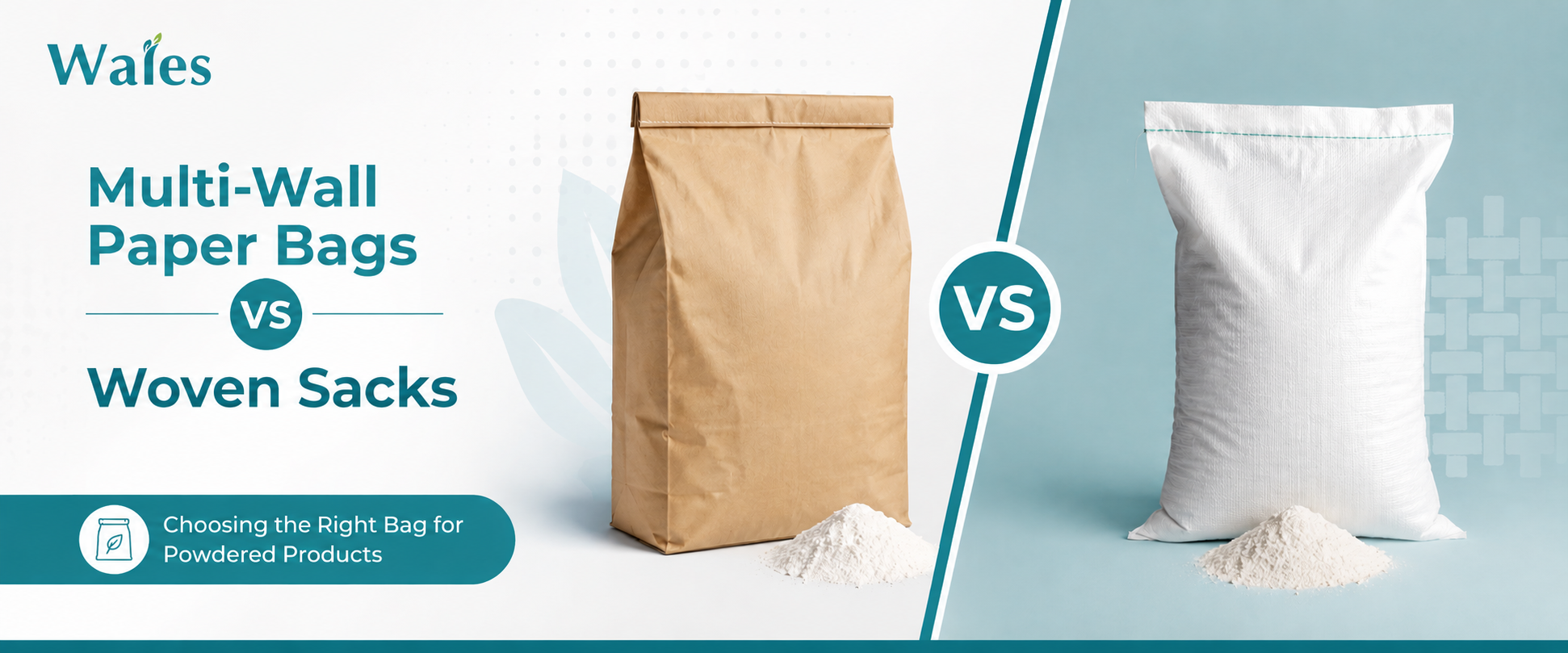
Powdered products are some of the hardest things to package well. Flour, cement, fertiliser, chemicals, and detergents all behave differently once they’re inside a bag.
Fine particles can escape through loose stitching. Moisture can turn a free-flowing powder into a solid lump. And a bag that looks fine on the shelf can fail the moment it’s stacked five high on a pallet.
Because of this, packaging suppliers spend a lot of time testing how bags hold up under real conditions, not just how they look in a photo. Two packaging types come up again and again for powdered goods: multi-wall paper bags and woven sacks. Both can do the job, but they suit different products, filling lines, and storage conditions.
This guide breaks down how each one works, where each one fits best, and how to think through the decision for your own product.
Powders don’t behave like grains, pellets, or chunky materials. A few things make them harder to pack well:
Keeping these points in mind makes it easier to compare the two bag types properly.
Multi-wall paper bags, also called block bottom bags or valve paper bags, are built with a flat base so the bag can stand upright once filled. This shape improves stacking and gives the bag a neater, more presentable look on a pallet or shelf.
They’re made without adhesives. Instead, the coating on the fabric is heat-welded, which gives the bag a brick-like shape once it’s filled and closed.
Product features include:
Multi-wall paper bags are commonly used for cement, chemicals, resin, polymer, granules, PVC compound, masterbatches, carbon, fertilisers, urea, minerals, sugar, salt, seeds, spices, cashew nuts, dates, barley, flour, rice, corn, and other food grains.
They’re generally described as eco-friendly and cost-effective, and can be produced in a range of inner and outer finishes that are air-resistant, moisture-proof, and recyclable.
They’re most often chosen for products where shelf appearance and stable stacking matter, such as food grains, flour, sugar, coffee, pet food, and seeds, alongside industrial powders like cement and chemicals. The flat base means the bag stands on its own, which helps with both storage and retail display.
PP woven sacks are made from high-strength woven fabric rather than paper layers. The woven structure gives them strong tear resistance and helps them hold their shape under load, which is why they turn up so often on job sites and in industrial settings.
Product features include:
They’re widely used for rice, wheat, sugar, flour, starch, seeds, fertiliser, cement, sand, aggregates, minerals, and recyclables. Wales Industries describes them as lighter in weight than many alternatives, with higher strength, better corrosion resistance, and good tear resistance across a wide range of uses.
According to Wales Industries, when they’re manufactured with food-grade polypropylene and produced under controlled conditions, PP woven sacks are suitable for food and agricultural products.
They’re also reusable multiple times, depending on how they’re handled, and recyclable at the end of their working life.
| Factor | Multi-Wall Paper Bags | PP Woven Sacks |
| Base shape | Flat, block-bottom, stands upright | Standard sack shape |
| Weight capacity | Wide range of sizes and thicknesses | Built for 10 to 100 kg packs |
| Moisture resistance | Can be made airtight or watertight with lamination or liner | Water resistance available with lamination or liner |
| Fabric/material | Paper layers, heat-welded coating, no adhesives | UV-stabilised woven polypropylene |
| Printing | Up to 8 colors | Customized colors |
| Common powdered contents | Cement, chemicals, powders, granules, resins, spices, grains, detergents, fertiliser | Flour, starch, sugar, fertiliser, cement, minerals |
| Recyclability | Recyclable, paper-based | Recyclable, plastic-based, often reusable first |
Both bag types are designed to hold powdered products, but construction details matter more than the material itself. A multi-wall paper bag relies on its layered structure and heat-welded coating to keep fine particles contained, while a PP woven sack depends on a tightly woven fabric and, where needed, a liner to stop sifting.
This is exactly why testing matters. Wales Industries carries out in-house lab testing on its products, including a sifting test, which checks how well a bag design holds fine or powdered material without letting it escape through the seams or fabric.
If your powder is sensitive to damp, both bag types can be built to handle it. Wales Industries offers lamination or a polyethylene liner on both multi-wall paper bags and PP woven sacks, so the choice often comes down to storage rather than which base material is “better” on paper.
Multi-wall paper bags are specifically noted as suitable for fully or semi-automatic filling lines, which matters if you’re running high volumes and need consistent bag shape for the equipment to work reliably.
A few practical starting points, based on how Wales Industries positions each bag type:
If you’re unsure which fits your product, it helps to talk through your filling line, storage setup, and transport conditions with your supplier before settling on a bag type.
Wales Industries has been manufacturing FIBC bulk bags and industrial packaging in Australia since 2016, giving the company more than 10 years of experience in the sector. The business supplies around 1.5 million products annually and has served more than 500 customers.
A few other facts worth knowing:
Both multi-wall paper bags and PP woven sacks can be customised in size, thickness, colour, lamination, and liner options to match your product and filling line.
Multi-wall paper bags and PP woven sacks can both do the job of packaging powdered products, but they get there in different ways. Paper bags offer a flat base for upright stacking, strong shelf presentation, and up to 8-colour printing, and they’re built for automatic and semi-automatic filling lines.
PP woven sacks bring a lighter, tear-resistant, UV-stabilised fabric that suits a wide range of industrial and food-grade powders.
The right choice depends on your product, how it’s stored, and how it moves through your supply chain. Sifting resistance, moisture protection, and filling line compatibility are the three things worth checking closely before you commit to a bag type.
Ready to talk through your packaging options? Wales Industries can help you choose between multi-wall paper bags and PP woven sacks based on your product, filling line, and storage needs, with custom sizing, lamination, liners, and printing available on both.
Related: Multi Wall Paper Valve Bags for Cement: The Reliable Choice for Modern Packaging
Australia
 中国 (China)