1300 786 560
 Australia
Australia
Australia
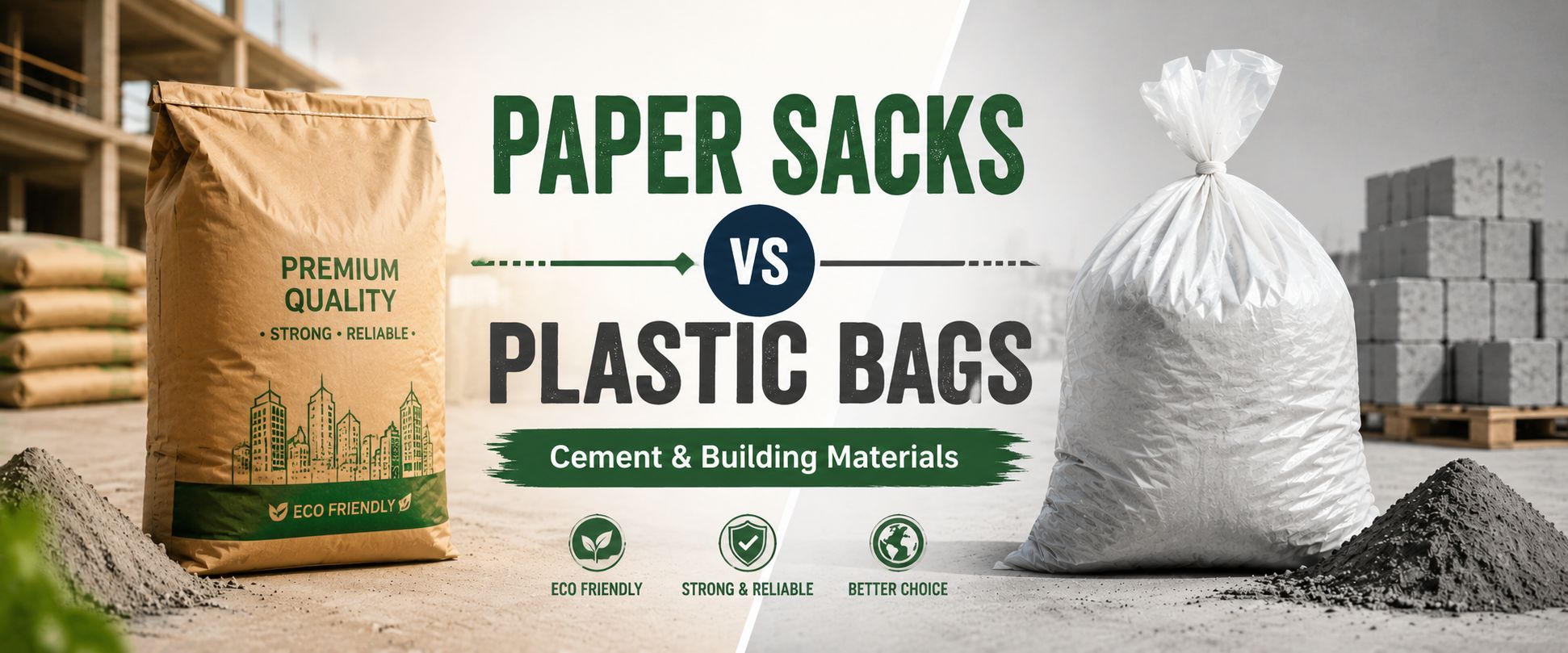
Cement and building material suppliers are regularly faced with the same packaging decision: paper or plastic. Both options protect the product, but they perform differently once bags are stacked, transported, and handled on site.
This guide compares paper sacks and plastic woven sacks across strength, moisture protection, cost, handling, and sustainability to help you choose the packaging that best suits your operation.
Paper sacks used for cement are usually multi-wall paper bags. They are made from several layers of kraft paper, sometimes with a polyethylene liner or lamination added for extra protection. Each layer serves a purpose, providing shape, puncture resistance, or moisture protection.
Multi-wall paper bags typically have a flat, block-shaped base, allowing the bag to stand upright on its own. This improves pallet stability and shelf presentation. This style is commonly used for cement, concrete mixes, chemicals, resins, and other dry building materials.
Key features of multi-wall paper sacks include:
When people say “plastic bag” for cement, they almost always mean a PP woven sack. Polypropylene tape gets woven into fabric, then stitched or heat-sealed into a sack. Some are laminated, or fitted with a poly liner, if extra moisture resistance is needed.
These sacks turn up everywhere dry bulk materials move: cement, sand, aggregates, minerals, and general building supplies. The woven structure is what gives them their reputation for holding up under rough handling, since a woven fabric doesn’t tear the way plain sheet material does.
What tends to matter most with PP woven sacks:
| Factor | Multi-Wall Paper Sacks | PP Woven Plastic Sacks |
| Strength | Strong, from layered paper construction | High tear resistance from woven fabric
|
| Moisture protection
|
Good, with a liner or lamination | Good, with a liner or lamination |
| Weight | A little heavier per bag | Lighter for a similar load
|
| Stacking | Very stable, flat base stands upright | Stable, though less naturally upright
|
| Outdoor storage | Best kept covered or lined | Handles sun and weather better as-is
|
| Recyclability | Recyclable, paper-based | Recyclable, plastic-based
|
| Filling line fit | Works on automatic and semi-automatic lines | Suited to bulk and industrial filling systems
|
| Branding | Up to 8-colour print on paper | Custom colours and print available
|
| Common use | Cement, concrete mixes, chemicals, resins, powders | Cement, sand, aggregates, minerals, recyclables
|
Both bags carry heavy building materials without much trouble, but they get there differently.
Paper sacks rely on layered kraft paper. Every extra layer adds a bit more strength and a bit more cushioning, so the bag can absorb the odd knock during loading or transport. That’s part of why they suit warehouses and retail-style stacking, where handling is a bit more controlled.
Plastic woven sacks lean on the fabric itself. A tightly woven polypropylene structure resists tearing even when it gets dragged, dropped, or piled under a heavy load, which explains why you see so many of them on busy construction sites.
Cement doesn’t forgive moisture. Even a light dampness can cause clumping and knock the product’s quality down a grade.
Paper sacks with a poly liner or lamination can hold up well against water. Without that liner, though, plain paper is the weaker option here, so how the bag is built matters more than what it’s made of.
Plastic sacks start from a stronger position, since woven polypropylene naturally resists water better than plain paper. Add a liner and the protection improves further. The UV-stabilised finish also helps if bags are sitting outdoors for a while.
Also Read: What is a Multiwall Industrial Paper Sack and Its Usage?
Both types run on automatic and semi-automatic filling lines, so production speed isn’t really the deciding factor.
Cost shifts depending on bag size, wall count, lamination, and order volume, so there’s no single number that applies across suppliers.
As a rough guide, plastic woven sacks often use less raw material per bag because the fabric is lightweight, while paper sacks may need extra layers to match that same strength.
It’s worth asking your supplier for a quote based on your actual volume and specs rather than going off general assumptions, since custom sizing and printing can move the final price either way.
Both paper and plastic cement sacks can be recycled, though the process looks different for each.
Multi-wall paper bags come from a renewable material and are generally seen as the more eco-friendly option in the packaging world. Whether they’re recyclable in practice depends on local facilities and whether a plastic liner is present.
PP woven sacks are recyclable too, and depending on how they’re handled, they can sometimes be reused several times before they’re recycled at all. That reuse can cut down on waste for businesses that keep bags in circulation before disposal.
Neither option wins outright on sustainability. It really comes down to your local recycling setup and whether reuse is already part of how you operate.
There’s no generic answer here. It comes down to how the bags will actually be used once they leave the warehouse.
Talk through your filling line, storage conditions, and transport method with your supplier before locking anything in.
Wales Industries manufactures both multi-wall paper bags and PP woven sacks for cement, concrete materials, and other bulk building products. Our team can walk you through the options based on your filling line, storage setup, and transport needs, and we offer custom sizing, lamination, liners, and printing to match.
If you’re still not sure which packaging fits your operation, get in touch, and we’ll help you work it out.
Contact Wales Industries today for a custom quote on paper sacks or PP woven sacks for your cement and building material packaging.
Yes, provided they’re built with multiple layers and, where needed, a liner or lamination. Multi-wall paper sacks are a standard choice for cement across the industry.
Plain PP woven sacks resist moisture better than plain paper on their own, but a laminated finish or poly liner takes that protection further.
Yes, depending on how they’re handled. They can often go through several uses before being recycled.
PP woven sacks tend to cope better with outdoor and rough site conditions, thanks to the woven, UV-stabilised fabric. Paper sacks are best kept under cover or fitted with a protective liner.
Yes, both multi-wall paper sacks and PP woven sacks can be made in custom sizes with printed branding.
Related Blog: Paper Sacks for Bakery Goods | Sustainable Bags by Wales
Australia
 中国 (China)